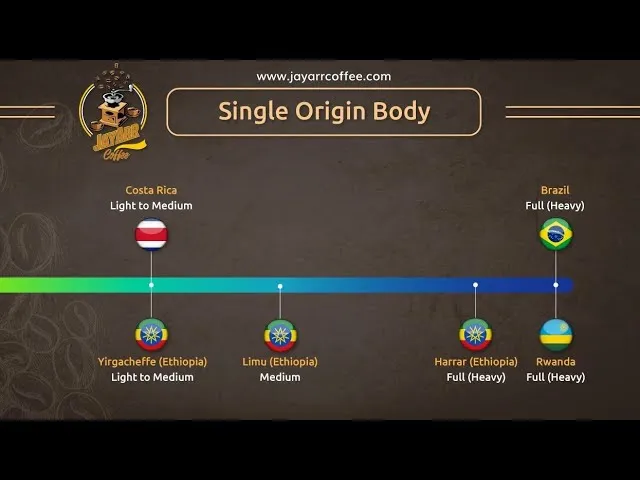
Single origin coffees let you taste what makes each region distinctive. In blends, those characteristics merge together. On their own, they’re unmistakable. Here are four origins worth exploring — each with a completely different personality.
Quick Guide: Match Your Taste
| Preference | Try This | Why |
|---|---|---|
| Low acidity, smooth | Brazil | Heavy body, nutty-chocolate, zero challenge |
| Floral, tea-like, complex | Ethiopia (washed) | Jasmine, bergamot, incredible clarity |
| Fruity, wild, bold | Ethiopia (natural) | Berry, grape, wine-like intensity |
| Balanced, approachable | Costa Rica | Sweet, clean, works at every roast level |
| Full body, syrupy | Rwanda | Lime, berry, caramel, real weight |
Brazil: Comfort in a Cup
Brazil produces roughly a third of all coffee on the planet — about 55 million bags per year. That dominance has held for over 150 years. The combination of relatively low elevation and non-volcanic soils produces coffee that’s smooth, mild, and dependable rather than complex: low acidity, nutty and chocolate sweetness, heavy body.
What you’ll taste: Almond, dark chocolate, caramel, sometimes dried fruit. Clean, smooth, and grounding. This is coffee that puts its arm around your shoulder — it’s not going to challenge you.
The Cerrado region (around 850–1,300 meters on terra rosa red earth soil) produces much of Brazil’s specialty grade. Full-bodied, consistent, with the chocolate and nut notes that define Brazilian coffee at its best.
Key varieties:
- Mundo Novo — A natural Typica x Bourbon cross. About 40% of Brazil’s production. Dark berry and chocolate notes.
- Catuaí — A cross between Caturra and Mundo Novo. High yield, good quality, widely planted.
- Bourbon Santos — Named after the port of Santos. Smooth, nutty, sweet. The classic espresso blend component.
Brazil’s signature processing method is pulped natural (cereja descascada) — removing the skin but leaving mucilage on during drying. This produces more body than washed but cleaner flavor than full naturals. It’s become the country’s trademark approach, and it’s part of why Brazilian coffee has that distinctive rich-but-clean character.
How to brew it: French press or espresso. Brazil’s heavy body and low acidity are made for immersion brewing. It’s the foundation of most Italian-style espresso blends for good reason — smooth, sweet, and forgiving under pressure. Medium to dark roast showcases the nutty-chocolate character best.
Best for: People who want reliable, comfortable coffee. Espresso lovers. Blend enthusiasts. Anyone who thinks “I don’t like acidic coffee.”
Ethiopia: Where It All Began
Ethiopia is the birthplace of all Arabica coffee and the most genetically diverse origin on earth — home to an estimated 6,000 to 15,000 distinct varieties, most unnamed and unstudied. The country produces 6.6 million bags per year and Ethiopians consume roughly half domestically — a level of appreciation that tells you how good their coffee is.
The processing method determines everything:
Washed Ethiopian coffees showcase clean, bright acidity with delicate floral and citrus notes — jasmine, bergamot, honeysuckle. Light to medium body, tea-like clarity. The acidity is predominantly citric — clean and lemon-bright. If you’ve never had a washed Yirgacheffe, it may be the single most eye-opening coffee experience available.
Natural Ethiopian coffees are bolder and sweeter — heavy body with pronounced berry, grape, cherry, and tropical fruit. Wine-like and sometimes wild. The whole cherry dries on the bean, contributing fruit sugars and fermentation complexity. These can taste almost nothing like washed coffees from the same region.
The three regions you need to know:
Yirgacheffe (1,700–2,200m) — The most celebrated Ethiopian region. Smoother, fruitier, more floral than other regions. Described as “explosively aromatic.” Both washed and natural Yirgacheffe are spectacular, but washed is where the region’s elegance shines brightest.
Harrar (eastern highlands) — Ethiopia’s oldest known cultivation area. Natural mocha flavor, wild berry notes, heavy body. These are bold, rustic coffees with real personality.
Limu (southwestern) — Sharper, wine-like, spiced floral. Underrated and often great value.
Why Ethiopian genetic diversity matters to you: Every other coffee-producing country grows varieties traced back to a narrow genetic base. Ethiopia’s forests contain the full spectrum of wild Arabica genetics. This is why Ethiopian coffees taste like nothing else — the genetic variety is literally unmatched. And as climate change threatens commercial varieties globally, Ethiopia’s genetic reservoir may be what saves coffee as we know it.
How to brew it: Pour-over for washed (V60 or Chemex for maximum clarity). French press or AeroPress for naturals (to capture the body and fruit). Light to medium roast only — darker roasts bury the complexity that makes Ethiopian coffee worth the premium.
Critical tip: Let the cup cool. Ethiopian coffees are among the most temperature-dynamic in the world. The bergamot in your Yirgacheffe and the berry in your Harrar often don’t fully appear until below 140°F. Taste at the first sip, then taste again five minutes later.
Best for: People ready for something that will change how they think about coffee. Flavor explorers. Anyone who loves floral or fruity flavors.
Costa Rica: The Reliably Excellent Origin
Costa Rica is the only country where growing Robusta is illegal — every bean is Arabica by law. The country pioneered honey processing, drove a micro-mill revolution (over 250 registered), and consistently produces coffee where over 70% scores specialty grade (80+ on the SCA scale). The quality floor is higher here than almost anywhere.
What you’ll taste: Floral or sweet notes, lighter medium body, mild acidity. Chocolate, citrus, stone fruit, caramel. The acidity is malic — smooth and apple-like rather than sharp. Everything about Costa Rican coffee is balanced and approachable.
Why processing matters here: Costa Rica pioneered the honey process — leaving varying amounts of mucilage on the bean during drying:
| Process | Character |
|---|---|
| Washed | Clean, bright, high clarity |
| White honey | Touch more sweetness than washed |
| Yellow honey | Noticeably sweeter, slightly more body |
| Red honey | Richer, fruitier, fuller body |
| Black honey | Maximum fruit and body, closest to natural |
A black honey Tarrazú and a washed Tarrazú from the same farm can taste like different coffees. That range, from a single origin, is remarkable.
The region that matters most: Tarrazú — highest altitude (1,500–2,000m), volcanic soil, the most complex and celebrated Costa Rican coffees. If you’re buying one bag, start here. Look for the SHB (Strictly Hard Bean) designation, which confirms high-altitude, dense beans.
How to brew it: Pour-over at medium roast is the sweet spot. A flat-bottom dripper (Kalita Wave) emphasizes the sweetness that Costa Rica does best. But honestly, Costa Rican coffee is so balanced that it works in everything — drip, French press, AeroPress, espresso.
Best for: People new to single origins who want something guaranteed to be good. Anyone who values consistency. People who want to explore how processing changes flavor.
Rwanda: Rebuilding Through Quality
After the 1994 genocide devastated its infrastructure, Rwanda made a deliberate choice to transform its coffee industry from low-grade bulk exports to specialty quality. The result: Cup of Excellence competitors producing full-bodied, syrupy coffees with bright lime and citrus notes, berry and floral flavors, and a distinctive caramel aftertaste. Rwanda produces roughly 220,000 bags per year — small but mighty.
What you’ll taste: Red apple, grape, berry, floral notes, bright lime acidity, and a syrupy body with caramel sweetness on the finish. These coffees have real weight and presence — they’re not delicate or subtle.
Most Rwandan coffee is the Bourbon variety — a heritage cultivar that produces lower yields but exceptional complexity. Grown at 1,400–2,000 meters and carefully wet-processed at centralized washing stations that enforce quality standards. The high altitude means dense, flavor-packed beans that extract efficiently — you get a lot of flavor per gram.
How it compares: Rwanda sits between Ethiopian complexity and Colombian smoothness. It has the fruit and floral notes of East African coffee but with more body and less of the challenging acidity. If Ethiopian coffee interests you but feels too intense, Rwanda is the gentler path into African origins.
The potato defect — what you need to know: Rwanda (and neighboring Burundi) occasionally produces beans with a distinctive flaw: individual beans that smell and taste like raw potato, caused by bacteria called Pantoea. It’s rare in well-sorted specialty lots, but worth knowing about so you don’t blame your technique if one cup tastes off. The defect is bean-specific, not lot-wide. If you catch the smell while grinding, remove the offending beans and proceed.
How to brew it: Pour-over to highlight the bright citrus and floral notes. Medium-fine grind, 200°F. Let the cup cool — like most high-altitude African coffees, Rwanda’s best flavors evolve with temperature. The caramel aftertaste that defines great Rwandan coffee often becomes most prominent as the cup drops below 140°F.
Best for: People who want full-bodied coffee with complex fruit notes. Anyone interested in the story behind their beans. Explorers looking beyond the obvious origins.
How to Start Exploring
If you’re new to single origins, here’s the practical path:
- Start with Costa Rica or Brazil — approachable, forgiving, hard to get wrong
- Try Ethiopian washed — your palate-expanding moment
- Compare Rwanda to Ethiopia — similar region, different personality
- Branch out — Kenya, Colombia, Guatemala, and beyond
Two tips that apply across all four origins:
Let the cup cool. The best flavors in high-quality single origins emerge below 140°F. Taste hot, then taste again five minutes later. The difference can be dramatic.
Buy fresh, store smart. Peak flavor is 7–21 days post-roast, with 3–4 days of rest after roasting. Store airtight, cool, dark — never refrigerate. If you find a lot you love, freeze portions in airtight bags. Properly frozen beans stay excellent for months, with oxidation dropping roughly fifteen-fold.
Once you start tasting the differences between origins, it’s hard to go back to generic blends.
Some links above are affiliate links. If you purchase through them, we earn a small commission at no extra cost to you.
Frequently Asked Questions
- What is the easiest single origin coffee for beginners?
- Costa Rica or Brazil. Costa Rican coffee is balanced, sweet, and approachable with mild acidity — over 70% of its output qualifies as specialty grade. Brazilian coffee is even gentler: low acidity, nutty-chocolate, and almost impossible to dislike. Both work across brew methods without special technique.
- Does single origin coffee go bad faster than blends?
- No — freshness depends on roast date and storage, not whether the coffee is single origin or blended. Peak flavor is 7–21 days post-roast for both. Store airtight, cool, and dark. The difference is that single origin coffees often come from smaller roasters who print roast dates, while blends from large brands often don't.
- Why does Ethiopian coffee taste so different from Brazilian coffee?
- Genetics, altitude, and processing. Ethiopia has 6,000–15,000 distinct varieties producing complex floral and fruity notes, grown at 1,700–2,200 meters. Brazil grows mainly Mundo Novo and Catuaí at lower elevations (800–1,400m), producing simpler nutty-chocolate profiles. Processing differences (Ethiopian washed vs. Brazilian natural) amplify the contrast further.
- Is single origin coffee better than blends?
- Neither is inherently better — they serve different purposes. Single origins showcase the unique characteristics of a specific region and reward attention. Blends combine origins to create balanced, consistent flavor profiles and are often better for espresso. Most specialty roasters produce excellent examples of both.