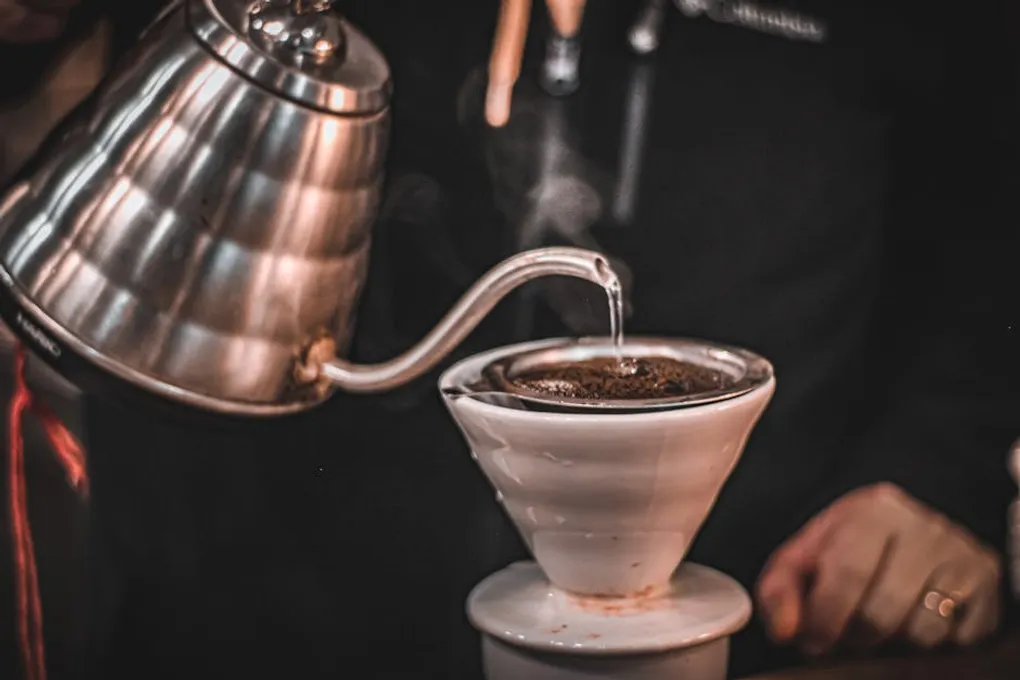
Pour hot water over fresh coffee grounds and something happens. The bed heaves, a dome forms, and CO2 bubbles break the surface. Most guides tell you this is degassing — the coffee “releasing trapped CO2” before you can brew. It’s a reasonable description of what you can see, but it misses what’s actually important.
Coffee scientist Jonathan Gagné, whose work synthesizes fluid dynamics and thermodynamics with real brewing practice, identifies the bloom differently: the primary function is wetting — establishing capillary contact between water and coffee. The CO2 release is a side effect of that process, not the goal. Getting this distinction right changes how you approach bloom and why it matters.
What Actually Happens During Bloom
When you grind coffee, you expose the interior of each cell to air. The roasting process produced CO2 inside the bean, and that gas remains trapped in the porous structure. It’s part of what makes fresh coffee smell like fresh coffee.
When hot water first contacts ground coffee, two things happen simultaneously. First, water is drawn into the coffee cells by capillary action — the same force that pulls liquid up through a paper towel. The physics here follow the Lucas-Washburn equation: liquid advances into a porous medium through capillary pressure, and the rate of advance depends on the surface tension of the liquid, the radius of the pores, and the wettability of the material. Coffee grounds, especially darker roasted ones with oilier surfaces, resist wetting — water doesn’t simply flood in immediately.
Second, as water penetrates the cells, it displaces the CO2 trapped inside, pushing it out through the liquid. That’s the bubbling you see — gas escaping through water. The dome forms because the bed swells as water enters and gas exits simultaneously.
The critical insight is that until water has made genuine capillary contact with the interior of each particle, extraction cannot happen properly. CO2 in the pores acts as a physical barrier, creating gas pockets that prevent water from touching the soluble compounds you’re trying to extract. The bloom isn’t about waiting for gas to leave — it’s about ensuring water gets in. One process enables the other.
The Freshness Test You’re Already Running
Here’s the practical consequence: the amount of CO2 your beans still contain determines how vigorously they’ll bloom. Fresh beans, roasted within the last 3–7 days, contain significant CO2 and will bloom dramatically — a tall dome, vigorous bubbling, the bed expanding to nearly twice its original volume. Beans roasted 2+ weeks ago may barely bloom at all, because most of the CO2 has already escaped during storage.
Jessica Easto, author of Craft Coffee: A Manual, makes this explicit: little or no bubbling during bloom indicates stale coffee. The bloom is a free freshness test every time you brew.
This creates a real paradox that confuses some home brewers. If you buy beans and brew them immediately after roasting, they can actually be too fresh — the CO2 outgassing during extraction is so vigorous that it interferes with even saturation and creates inconsistent extraction. Specialty roasters who ship direct often recommend a rest period of at least 3–7 days post-roast before brewing pour over, and 3–4 days minimum for espresso. The rest period allows some CO2 to escape naturally so the bloom becomes productive rather than overwhelming.
The coffee freshness guide covers the full degassing timeline — how CO2 loss progresses from roast day through peak flavor window and into stale territory.
Why CO2 Matters for Espresso Differently
In pour over, CO2 creates gas pockets that prevent even wetting — annoying but manageable with a proper bloom. In espresso, the same CO2 creates a much more serious problem: channeling.
Espresso forces water through a compact coffee puck at 9 bars of pressure. CO2 bubbles in the puck create physical gaps — weak points in the resistance that the pressurized water exploits. Water finds these paths of least resistance and blasts through them, massively over-extracting those channels while leaving surrounding coffee almost untouched. The result is a shot with simultaneous over- and under-extraction — bitter and sour at once.
This is why freshly roasted espresso is almost always undrinkable. Most specialty roasters recommend 3–4 days minimum rest for espresso, with many darker blends performing best at 10–14 days post-roast. The bloom paradox for pour over becomes a channeling crisis for espresso.
How to Bloom Correctly
The mechanics are simple but a few decisions matter.
Water amount: Use 2–3 times the coffee dose weight. For a typical pour over with 22g of coffee, that’s 44–66g of water. This is enough to fully saturate the bed without running through the dripper into the vessel below. The goal is complete wetting with no bypass — if water is draining before the bloom period ends, you’ve used too much.
Water temperature: Use the same temperature you’ll brew with. Bloom water that’s significantly cooler than brew water can cause uneven extraction in the first main pour, since parts of the bed were pre-heated differently. Keep it consistent. For most light-to-medium roasts, that means water around 200–205°F / 93–96°C.
Bloom time: 30–45 seconds. This is where the major sources converge — Easto, Gagné, and Scott Rao all land in this range. Gagné specifically uses 45 seconds. For very fresh beans (within 5 days of roast), you can extend to 45–50 seconds. For beans at 2+ weeks, 30 seconds is sufficient.
The swirl: Gagné recommends immediately swirling the dripper after adding bloom water, before letting it sit. The goal is ensuring every part of the dry bed gets touched by water — a center-only bloom pour can leave the edges dry, and swirling creates even distribution. For a Kalita Wave or flat-bottom dripper, this is especially useful since water doesn’t naturally spread sideways as well as it does in a V60 cone.
Pour technique: Add bloom water slowly and deliberately, starting from the center and spiraling outward. The goal is every ground getting wet, not filling the dripper quickly. Once you’ve saturated the bed, stop and wait.
What Happens If You Skip Bloom
Pouring the full water volume directly over dry grounds without a bloom phase creates predictable problems. CO2 in the grounds creates gas pockets throughout the bed. Water finds paths around these pockets rather than through them — the same channeling mechanism that plagues espresso, just at lower pressure. Some grounds get over-extracted while others barely get touched. The resulting cup often tastes simultaneously sour (under-extracted zones) and bitter (over-extracted zones), with a hollow, muddy quality.
The effect is more pronounced with very fresh beans (lots of CO2) and less noticeable with older beans (little CO2 left). This is one reason stale coffee can occasionally “get away with” a skipped bloom — there’s simply less CO2 to create interference. But by the time beans are stale enough that the bloom doesn’t matter, you’ve already lost the flavor that made the bloom worth doing.
Bloom Variations by Method
V60: Classic center-spiral bloom pour, then swirl. The cone shape naturally funnels water toward the center — make sure you spiral all the way to the edges.
Kalita Wave: The flat-bottom bed means water doesn’t self-distribute as easily. Swirl after the bloom pour is particularly important here. Some brewers use a spoon or chopstick to gently stir the bloom instead.
Chemex: Same bloom principles apply, but Chemex filters are 20–30% thicker than standard filters, which slows wetting slightly. Use a generous bloom (3x dose weight) to ensure full bed saturation before the paper’s resistance becomes a factor.
AeroPress: The AeroPress’s short brew time and immersion mechanics mean bloom is less critical than for pour over. But a 30-second bloom still improves extraction evenness, particularly with fresh beans. Add bloom water, swirl, and wait before completing the fill.
French press: Most French press guides don’t mention bloom because the long immersion time (Hoffmann recommends up to 12 minutes) compensates — CO2 has time to escape and wetting eventually becomes complete regardless. If you’re using very fresh beans and have a 4-minute brew, a 30-second bloom is worth doing. For most home French press brewers, skip it.
The Relationship Between Bloom and Extraction
Once you understand that bloom is fundamentally about achieving even capillary contact, the downstream effects on extraction become obvious. Even wetting → consistent resistance through the coffee bed → water takes similar paths through every part of the grounds → each particle extracts at roughly the same rate → the cup tastes balanced.
This connects directly to the concept of extraction evenness that Gagné identifies as the hidden variable in great coffee. A cup at 20% average extraction yield with uneven extraction (some particles at 25%, others at 15%) tastes worse than a cup at 19% with perfectly even extraction. The bloom is one of the most reliable tools for pushing toward the even side of that spectrum — not because of what it removes (CO2), but because of what it establishes (contact).
For a complete picture of how extraction mechanics work, the coffee extraction yield guide covers the full sequence of compounds that dissolve during brewing and why the order matters.
Gear That Makes Bloom Easier
The single most useful tool for a good bloom is a gooseneck kettle. The narrow spout gives you the flow control to saturate the bed slowly and evenly — you can hit a spiral pattern that covers every part of the grounds without disturbing the bed or overshooting your water weight. A standard kettle produces an uncontrolled pour that’s almost impossible to distribute precisely.
A scale is the second key tool. Measuring your bloom water to 2–3x dose weight is much easier with a scale than estimating by eye — especially with the 5–10 second window between starting a pour and reaching your target. The coffee scale reviews cover the options worth considering.
If you want to go further, an electric variable-temperature gooseneck kettle lets you hold water at your target temperature throughout both the bloom and the main pour — no guessing, no cooling between steps.
The Bottom Line
Coffee bloom is about wetting, not degassing. The CO2 bubbles are a symptom of capillary action doing its work — water forcing its way into porous particles and displacing the gas that was there first. The 30–45 seconds of bloom time isn’t arbitrary; it’s the time needed for water to establish contact with the interior of every ground particle, eliminating the gas-pocket barriers that would otherwise cause uneven extraction.
Vigorous bubbling means fresh beans. Flat bloom means stale beans. No bloom at all means you’re either pouring too slowly to see it or your beans have been sitting for weeks. Any of those is useful information before you’ve taken your first sip.
Frequently Asked Questions
- What is coffee bloom?
- Bloom is the initial phase of pour over brewing where a small amount of hot water saturates the coffee grounds before the main pour. The primary function, per coffee scientist Jonathan Gagné, is establishing capillary contact between water and every ground particle — wetting the coffee so extraction can proceed evenly. The CO2 release and dome formation are side effects of water entering the porous grounds and displacing trapped gas.
- How long should you let coffee bloom?
- 30–45 seconds is the consensus across major sources. Gagné uses 45 seconds specifically. For very fresh beans (within 5 days of roast) you can extend to 50 seconds. For beans 2+ weeks old, 30 seconds is sufficient since most CO2 has already escaped. The goal is allowing time for capillary wetting to reach the interior of each particle — rushing this leaves dry zones that under-extract.
- How much water do you use to bloom coffee?
- 2–3 times the weight of your coffee dose. For 22g of coffee, that's 44–66g of bloom water. The target is complete saturation of the grounds without water draining through into your vessel before the bloom period ends. If water is dripping into your cup during bloom, you've used too much or poured too fast.
- Why is my coffee not blooming?
- Two likely causes: stale beans or a technique issue. If your beans are more than 2–3 weeks post-roast, most CO2 has already escaped and the bloom will be minimal — this is a freshness indicator, not a brewing failure. If you're using fresh beans with no bloom, check that you're pouring hot water (93–96°C / 200–205°F) and making direct contact with the full coffee bed, not just the center.
- Does coffee bloom affect taste?
- Yes, meaningfully. Skipping bloom with fresh beans allows CO2 pockets to remain in the grounds, creating gas barriers that prevent even wetting. Water channels around these barriers rather than through them, causing some grounds to over-extract while others barely extract at all. The result is a cup that tastes simultaneously sour and bitter — the signature of uneven extraction. The bloom directly enables the even saturation that produces a balanced cup.
- Do you need to bloom espresso?
- Not in the same way as pour over, but the related concept — resting beans post-roast — is critical for espresso. CO2 in a freshly roasted espresso puck causes channeling: pressurized water exploits gas-pocket weak points and blasts through them, over-extracting those channels while bypassing the rest. Most specialty roasters recommend 3–4 days minimum rest for espresso, with many blends performing best at 10–14 days post-roast. Some espresso machines have a pre-infusion feature that functions similarly to bloom.
- Should you bloom French press coffee?
- It's optional and less critical than for pour over. The long immersion time (4–12 minutes) gives CO2 time to escape naturally and allows wetting to eventually complete regardless. If you're using very fresh beans (within 5 days of roast), a 30-second bloom before adding the full water volume can improve extraction evenness. For most home French press brewers using beans 1–2 weeks old, the bloom step isn't necessary.
Some links above are affiliate links. If you purchase through them, we earn a small commission at no extra cost to you.