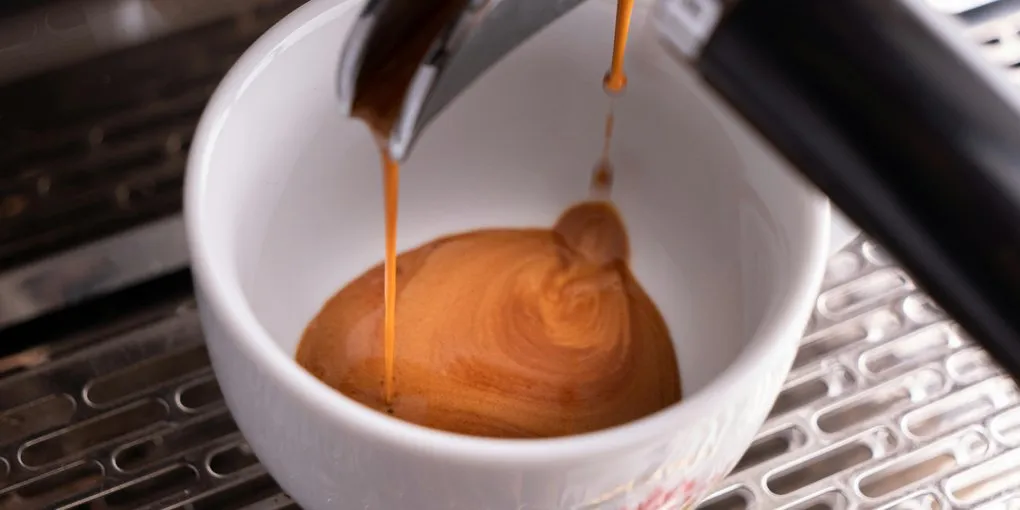
If you don’t make espresso, the whole thing looks ridiculous.
Someone puts a cup on a scale. Then they weigh exactly 18 grams of coffee. They spray the beans with water. They grind into a tiny metal basket. They stir the grounds with needles. They tamp them flat. They start a timer. They stop the shot by weight. And they act like three seconds ruined breakfast.
From the outside, it looks like coffee cosplay. But most of that fuss isn’t personality. It’s control.
Your espresso machine doesn’t make espresso. The puck does.
Definition First
Espresso is coffee brewed by forcing hot water through a compact bed of finely ground coffee, at high pressure, in a short amount of time.
Traditionally, that’s about 9 bar of pressure, 25 to 30 seconds, and a 1-to-2 ratio of dry coffee to liquid espresso. Those are reference points, not laws. Recent espresso research suggests flow actually peaks around 7–9 bar at the group head, then declines as bed compression outpaces flow promotion — so 9 bar isn’t a magic number. It’s a useful starting point.
Crema isn’t proof a shot is good either. Robusta beans produce more crema than premium arabica because robusta has higher chlorogenic acid content and a different lipid profile — but a robusta-rich crema doesn’t mean the cup tastes better.
The real thing that makes espresso different is concentration under resistance. You’re pushing a small amount of water through a dense bed of coffee fast enough to be intense, but slow enough to extract sweetness, aromatics, body, and controlled bitterness. That balance is why espresso is so good. And why it’s so unforgiving.
A Short History of an Old Problem
Espresso started as a speed problem. In the 1880s, Italian café coffee was slow — busy shops needed coffee faster than manual brewing could manage during a rush.
Angelo Moriondo, a Turin hotelier, patented the first fix in 1884 — a steam-pressure machine that brewed coffee in batches. It was faster. It was also harsh. Steam tops out around 1.5 bar of pressure, and to generate even that, you have to push water past 120°C. At that temperature, you don’t extract flavor — you extract bitterness.
Luigi Bezzera spent the next decade and a half adapting Moriondo’s idea for individual cups, patenting his improvements in 1901. Desiderio Pavoni bought Bezzera’s patent rights in 1903 and unveiled the commercial machine at the 1906 Milan World’s Fair. They were fast. Workers stood at the bar, drank a coffee, and left. Italian café culture was built on that pace.
But every machine for the next forty years had the same fundamental problem — they couldn’t generate pressure without using steam. And steam meant heat. And heat meant bitterness.
The fix arrived in the late 1940s. Achille Gaggia patented his lever-and-spring machine in the 1930s, and the first commercial machines went into production in 1947–1948 in Milan. Gaggia’s machine didn’t use steam to generate pressure. The barista pulled a lever; a strong spring compressed water against the coffee at roughly 8–10 bar, at a much lower temperature — around 92–96°C.
For the first time, espresso worked. High pressure, low temperature, 25 seconds of contact time produced something nobody had tasted before — a thick golden-brown layer of foam called crema, sitting on top of a dark, complex liquid.
The Turn: The Puck Is The Valve
Gaggia’s lever didn’t make better espresso by itself. The lever made it possible for the puck — the compressed bed of coffee grounds — to behave the right way under pressure.
The machine supplies hot water and force. The puck creates the resistance that turns that pressure into extraction. As the shot runs, the puck compresses, fines migrate, CO₂ gets displaced, and resistance changes throughout. The puck isn’t a static pile of coffee. It’s a porous bed, a temporary filter, a changing structure of particles, gaps, trapped gas, oils, and water.
So when people say “my machine makes 9 bar,” they’re describing one side of the system. The machine supplies pressure. The puck decides what that pressure becomes — a balanced extraction, a sour gush, a bitter choke, or a channel shooting water through one weak spot.
That’s why espresso people obsess over the grinder. The grinder isn’t making coffee smaller. It’s building the valve.
Why The Grinder Matters More Than The Machine
For most of espresso’s history, dark roasts made it predictable. Soluble, strong, milk-friendly. Then specialty coffee changed the target — brighter, denser, more expressive coffees. Espresso stopped being a recipe and became a method. Grind moves. Time moves. Dose moves. The fuss didn’t appear because espresso people are precious. It appeared because the coffee got more expressive.
Every grinder produces a particle-size distribution — not one size, but a range of larger particles, smaller ones, and a lot of tiny fines. For espresso, those fines aren’t dust. They’re the part that determines how resistant the puck becomes. Espresso burrs are designed to produce bimodal distributions — a main peak of consistent particles plus a fines peak that creates the resistance espresso needs.
Jonathan Gagné, the astrophysicist who literally wrote The Physics of Espresso, opens his chapter on grinders with this:
The grinder is probably the piece of equipment that has the largest impact on the taste of espresso.
That’s not a hot take. It’s the consensus among everyone who has measured this. When you dial in espresso, you’re often dialing in the amount of fines more than the average size of the larger particles.
A better grinder gives you a more useful distribution — fewer clumps, less retention, a puck that behaves predictably. A cheap or dull grinder gives you fines and boulders at the same time. The fines slow or clog the shot. The boulders under-extract. The cup ends up tasting hollow, sour, bitter, and muddy all at once.
That’s why upgrading the machine often disappoints people. If the puck is inconsistent, a better pump just applies better-controlled force to a bad resistance system. The espresso doesn’t get good because the machine got shinier. The puck still has to behave.
Why Scales And Timers Aren’t Gimmicks
Espresso is a ratio drink. Dose in. Beverage out. If you start with 18 grams of coffee and stop at 36 grams of espresso, you have a 1-to-2 shot. If you dose 19 grams or stop at 42, it’s not the same recipe.
Espresso is also too concentrated for volume to be reliable. Crema changes volume. Fresh beans make more gas; older beans make less. A shot that looks like 60 mL today might look like 30 mL in two weeks — at the same beverage weight. So you weigh it. Not because grams are romantic. Because mass is the stable measurement.
The timer matters for the same reason. Time is contact time. If the same dose and yield takes 15 seconds, water didn’t spend long enough with the coffee. If it takes 50 seconds, something changed. The timer doesn’t tell you whether the shot tastes good. It tells you whether the system changed. Scale for recipe. Timer for resistance.
Puck Prep — What Helps, What’s Theater
Puck prep is where espresso gets weird-looking. WDT needles. Blind shakers. Self-leveling tampers. Puck screens. Paper filters. Some of it helps. Some of it is workflow preference. Some of it is theater.
The principle is simple: you’re trying to make water flow through the puck evenly. If there are clumps, cracks, or density gradients, water finds the easiest path. That path gets too much water; other parts get too little. The cup tastes both sour and bitter at the same time.
That’s why WDT — the Weiss Distribution Technique, the needle tool — can help, especially with clumpy grinders. Gagné’s measurements show peak resistance varies about 40% shot-to-shot with surface WDT, and that deep WDT significantly tightens the grouping.
Tamping harder is usually not the answer. Any tamping force is immediately relieved when the coffee particles are wetted. Synthesis data is blunt: tamping force beyond the modest range used by most baristas adds very little, and some fancy convex tampers actually make extraction worse. Tamper fit matters more than tamper force — the ideal tamper diameter is 0.25–0.30 mm smaller than the basket inner diameter (a 58.7 mm basket pairs with a 58.4 mm tamper). Too-loose tamper → side channeling → roughly 0.5 percentage point extraction loss, invisible visually, measurable by refractometer.
Level matters. Consistency matters. Force is the least interesting part.
What This Means Tomorrow Morning
Stop treating the machine as the first suspect.
- If your espresso is sour and fast, the puck didn’t create enough resistance. Grind finer, or increase yield carefully, and taste again.
- If it’s bitter and slow, you may have too much resistance — too fine a grind, too long a contact time, or too much yield. Pull back one variable at a time.
- If it’s sour and bitter together, think uneven flow before roast level. Distribution. Clumps. Channeling. Basket fit.
- If a shot was good once and impossible to repeat, think consistency. Same dose. Same yield. Same prep.
The basic kit matters more than people admit:
- A capable grinder
- A scale that reads to a tenth of a gram
- A timer
- A simple WDT tool, if your grinder clumps
- A consistent tamp
That’s enough to understand most espresso problems before shopping for a new machine.
The Espresso Machine Is The Heat Source
After all the history, pressure, and physics, espresso comes down to one practical idea. You’re not making a drink by pressing a button. You’re building a small hydraulic system out of ground coffee.
The machine supplies hot water and force. The grinder builds the resistance. The scale controls the recipe. The timer shows whether the flow changed. And puck prep gives the water fewer excuses to misbehave.
The chrome box on your counter is just a heat source. Your grinder, your scale, your puck — that’s the espresso machine.
If you want the deeper version of why the grinder matters more than the machine, watch Coffee Grinder Science: Why It Matters More Than Your Machine next. For dialing in espresso step by step, see our guide on pressure profiling — actually a misnomer for what most home machines do — and on the bean-resting freshness trap that makes espresso unrepeatable from one week to the next.
Frequently Asked Questions
- What is espresso, exactly?
- Espresso is coffee brewed by forcing hot water through a compact bed of finely ground coffee at high pressure in a short time. Traditional reference points are about 9 bar of pressure, 25–30 seconds of contact time, and a 1-to-2 ratio of dry coffee to liquid espresso. But the defining feature isn't any single number — it's concentration under resistance. The puck of compressed grounds is what turns the machine's pressure into extraction.
- Why does the grinder matter more than the espresso machine?
- The machine supplies hot water and pressure. The puck — built by the grinder — creates the resistance that determines flow. A grinder produces a particle-size distribution (not one size); the amount of fines in that distribution controls how resistant the puck becomes. A cheap or dull grinder gives you fines and boulders at the same time, which produces uneven extraction — the cup tastes hollow, sour, bitter, and muddy all at once. Upgrading the machine without fixing the grinder applies better-controlled force to a bad resistance system.
- Is 9 bar of pressure really the magic number for espresso?
- 9 bar is a reference point, not a law. Research summarized by Scott Rao and Jonathan Gagné shows that flow rate through the coffee bed actually peaks around 7–9 bar at the group head, then declines as bed compression outpaces flow promotion. Many modern machines run lower group-head pressures (6–7 bar) and can produce excellent espresso. The right pressure is the one that produces the highest flow rate while extracting cleanly — not necessarily 9.
- Why do baristas weigh the espresso shot?
- Espresso is a ratio drink. If you dose 18 g of coffee and stop the shot at 36 g of liquid espresso, you have a 1-to-2 shot. Volume isn't reliable — crema changes shot volume dramatically as beans age, but the brewed weight stays stable. A shot that looks like 60 mL today might look like 30 mL in two weeks at the same beverage weight. Mass is the stable measurement, which is why scales replaced eyeballing the shot glass.
- Does tamping pressure actually matter?
- Less than people think. Any tamping force is immediately relieved once coffee particles are wetted by the brew water. The standard advice of 30 lb / ~14 kg is well past the threshold of diminishing returns; tamping force beyond about that range adds very little, and convex tampers can actually make extraction worse. What matters more is tamper fit (the ideal tamper is 0.25–0.30 mm smaller than the basket inner diameter) and tamping level. A too-loose tamper causes side channeling that costs about 0.5 percentage points of extraction — invisible visually, measurable by refractometer.
- What's WDT and is it worth the trouble?
- WDT is the Weiss Distribution Technique — a tool with thin needles that breaks up clumps and redistributes the grounds before tamping. It helps most with grinders that clump. Jonathan Gagné's measurements show peak resistance can vary about 40% shot-to-shot with surface WDT alone, and deep WDT significantly tightens that grouping. If your grinder produces clumpy output, WDT is one of the highest-impact small upgrades you can make. If your grinder doesn't clump, the gain is smaller.
- What's the cheapest setup that can make good espresso?
- A capable grinder, a scale that reads to a tenth of a gram, a timer, a simple WDT tool, and a consistent tamp. The grinder is the load-bearing piece — most experienced baristas spend more on the grinder than on the machine. A modest semi-auto machine (Gaggia Classic Pro, Breville Bambino Plus, or similar) paired with a quality single-dose grinder will outperform an expensive machine paired with a budget grinder.