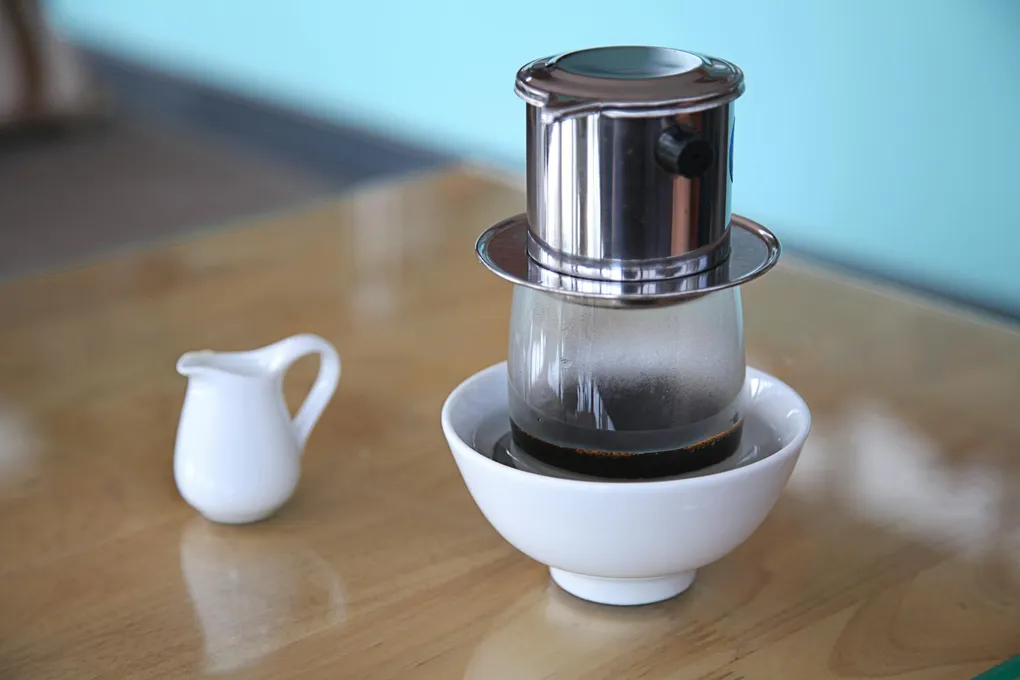
Vietnamese coffee is one of those things that makes you wonder why the rest of the world has been doing it differently. A small stainless steel filter sits on top of a glass. Dark, intense coffee drips slowly through — thick, almost chocolaty, with a roasted bitterness that’s the point, not the problem. At the bottom of the glass, two tablespoons of sweetened condensed milk are waiting. You stir it together, pour it over ice, and the result is one of the most satisfying iced coffee drinks in the world.
This is ca phe sua da — literally “coffee milk ice” — and it’s Vietnam’s national drink. The brewing method behind it, the phin filter, is so simple it’s almost primitive: four pieces of stainless steel, no moving parts, no electricity, nothing to break. But it produces a style of coffee so distinct that once you’ve had a good one, you’ll understand why 100 million people drink it this way every day.
How the Phin Works
The Vietnamese phin is a single-cup gravity drip filter. It’s not immersion (French press) and it’s not pressurized (espresso). It’s pure percolation at the most basic level: hot water sits on top of a bed of ground coffee and gravity pulls it through.
The phin has four components:
Plate: A small perforated disc that sits on top of your cup or glass, creating a stable base.
Brewing chamber: A cylindrical cup with tiny holes in the bottom. This holds the coffee grounds.
Press/filter screen: A perforated disc that sits on top of the grounds inside the chamber. You twist it down to compress the bed slightly. This controls flow rate — tighter press means slower drip, longer contact time, stronger coffee.
Lid: Sits on top to retain heat during the 4–5 minute brew.
The design descends from the French drip pot (cafetiere a biggin), patented in 1795 — a relic of French colonial influence in Vietnam. But the Vietnamese made it their own. The French brought the equipment; the Vietnamese figured out what to do with robusta, condensed milk, and ice.
Why Robusta?
Here’s where Vietnamese coffee diverges from almost every other specialty coffee conversation. Vietnam grows almost exclusively robusta — roughly 95–97% of its production. This isn’t a compromise. It’s the whole point.
Coffee arrived in Vietnam in 1857 via French Catholic missionaries. They planted arabica, but coffee leaf rust devastated those crops by the mid-1950s. Robusta, which is naturally resistant to rust, thrived. After the Doi Moi economic reforms of 1986, coffee production exploded — Vietnam went from a minor producer to the world’s second-largest (after Brazil), now exporting over 30 million bags annually from 730,000 hectares.
Robusta gets dismissed in specialty circles: more caffeine, more bitterness, less aromatic complexity. All of that is true in a vacuum. But Vietnamese coffee culture didn’t develop around black pour overs and delicate fruit notes. It developed around condensed milk, ice, and strong flavor — a context where robusta’s intensity is an asset, not a flaw.
The bitterness of a dark-roasted robusta cuts through sweet condensed milk in a way that a washed Ethiopian never could. The heavy body stands up to ice dilution. The chocolaty, nutty, slightly smoky flavor profile pairs with sweetness the way dark chocolate pairs with caramel. The Vietnamese didn’t settle for robusta — they built a coffee culture around its strengths.
That said, the “fine robusta” movement is gaining legitimacy. Carefully processed robusta can score 80+ on the SCA scale, with chocolate, caramel, and even fruit notes. Vietnamese specialty roasters are increasingly proving that robusta isn’t inherently inferior — just different.
Step by Step: Classic Ca Phe Sua Da
What You Need
Phin filter: Stainless steel, 4 oz or 8 oz size. Available for $5–10 online. The screw-press style gives you more control than the gravity-press style.
Coffee: Medium-coarse to coarse grind, dark roast. Traditional Vietnamese coffee often includes a small amount of chicory or is butter-roasted, which adds sweetness and body. Brands like Trung Nguyen and Nguyen Coffee Supply are widely available and purpose-built for phin brewing.
Condensed milk: Longevity brand is the classic choice in Vietnam. Any sweetened condensed milk works.
Ice: Lots of it.
The Recipe
Coffee: 14g (about 2 tablespoons, slightly heaped) Water: 120ml (4 oz) just off the boil, 95–100°C / 205–212°F Condensed milk: 2–3 tablespoons Grind: Medium-coarse — coarser than pour over, closer to French press Total brew time: 4–5 minutes
1. Set Up the Glass
Add 2–3 tablespoons of sweetened condensed milk to a heat-resistant glass. Place the phin plate on top of the glass.
2. Add Coffee and Press
Put the ground coffee into the brewing chamber. Give it a gentle shake to level the bed. Place the press screen on top and twist it down until it contacts the grounds with light-to-moderate pressure. Don’t crank it — too tight and the drip will be painfully slow or stop entirely.
3. Bloom
Add about 30ml (1 oz) of hot water — just enough to wet all the grounds. Place the lid on and wait 30–60 seconds. This bloom step lets the coffee degas and swell, which creates a more even extraction. You’ll see the press screen rise slightly as the grounds expand.
4. Add the Rest of the Water
Pour the remaining hot water (90ml) into the chamber. Place the lid back on. Now wait.
5. Watch and Wait
The coffee should drip steadily — not a stream, not individual drops separated by seconds, but a slow, consistent drip. The total brew time should be 4–5 minutes. If it’s rushing through in 2 minutes, your grind is too coarse or your press isn’t tight enough. If it takes 8+ minutes, loosen the press or grind coarser.
6. Stir, Ice, Drink
When the dripping stops, remove the phin. You’ll have about 3–4 oz of dark, concentrated coffee sitting on top of a layer of condensed milk. Stir thoroughly until the milk is fully incorporated — the liquid will turn a rich caramel brown.
Fill a tall glass with ice. Pour the coffee-milk mixture over the ice. Stir once more. Done.
Ca Phe Den (Black Vietnamese Coffee)
Not everything needs condensed milk. Ca phe den is the same phin process served black — either hot (ca phe den nong) or iced (ca phe den da). Without the milk to buffer the bitterness, the coffee’s full intensity comes through. This is where a good-quality dark roast really matters. Cheap robusta served black can be punishing; a well-roasted Vietnamese coffee served black is bold, chocolaty, and surprisingly smooth.
The Variations
Vietnamese coffee culture is inventive. A few worth knowing:
Egg coffee (ca phe trung): Invented in 1946 by Nguyen Van Giang at Hanoi’s Sofitel Metropole hotel during the French War, when fresh milk was scarce. Egg yolk is whipped with sugar and condensed milk until thick and custard-like, then spooned on top of strong black coffee. His Cafe Giang still operates in Hanoi’s Old Quarter and is a pilgrimage site for coffee lovers. The result tastes like coffee tiramisu — rich, creamy, sweet, and completely unlike anything else.
Coconut coffee (ca phe cot dua): Coconut cream or coconut milk blended with condensed milk and poured over phin-brewed coffee. Cool, tropical, and dangerously drinkable.
Salt coffee (ca phe muoi): Originated in Hue. A pinch of salt in the condensed milk layer — the salt suppresses bitterness and enhances sweetness, the same principle that makes salted caramel work.
Yogurt coffee (ca phe sua chua): Yogurt, condensed milk, and coffee. Tangy, sweet, creamy, cold. Sounds strange, works beautifully.
Health Notes
The phin filter is metal with no paper — so like French press and Turkish coffee, it passes cafestol and kahweol into the cup, the diterpene lipids that raise LDL cholesterol. The concentration won’t be as extreme as Turkish coffee (where grounds stay in the liquid), but it’s meaningfully higher than paper-filtered methods.
The condensed milk adds significant sugar and calories — about 130 calories and 22g of sugar per 2-tablespoon serving. That’s the trade-off for the flavor. If you’re watching sugar intake, you can reduce the condensed milk, substitute evaporated milk (unsweetened), or drink it black.
Caffeine is on the higher side because robusta contains roughly twice the caffeine of arabica: 2.2–2.7% vs. 1.2–1.5% by weight. A single phin brew with robusta delivers roughly 100–150 mg of caffeine in a small serving. Track your daily intake with our Caffeine Calculator.
What to Expect in the Cup
Phin coffee served as ca phe sua da is sweet, bold, and deeply satisfying. The condensed milk provides a caramel sweetness and silky body. The dark-roasted robusta provides bitterness, chocolate, roasted nut, and a slight smokiness that anchors the drink. The ice makes it refreshing without diluting the intensity — the concentrated brew is designed to be iced.
Black phin coffee (ca phe den) is heavy-bodied, low in acidity, and intense. It’s closer to moka pot coffee in character than to pour over — roasty, deep, with a slight thickness from the metal filter letting oils through.
Choosing a Phin and Coffee
The phin itself is inexpensive and nearly indestructible. Stainless steel models from Vietnamese brands run $5–10. The screw-press style gives you more control over flow rate than the gravity-press style. Size-wise, a 4 oz (single serving) is standard. Larger 8 oz models exist for making two cups.
For coffee, start with a purpose-built Vietnamese coffee. Nguyen Coffee Supply (available at Whole Foods, Target, and online) sources directly from Vietnamese farms and offers both robusta, arabica, and blends in phin-appropriate grinds. Trung Nguyen is the largest Vietnamese brand and easy to find. If you want to experiment, any dark-roasted coffee ground medium-coarse will work in a phin, though the results will taste different from the traditional robusta profile.
Final Thoughts
The phin filter costs less than a fancy latte and lasts forever. It makes one perfect cup at a time with zero waste, zero electricity, and zero learning curve longer than a single brew. The coffee it produces — intense, full-bodied, built to stand up to condensed milk and ice — represents an entirely different philosophy from the clarity-chasing light-roast pour overs that dominate specialty coffee.
Neither approach is better. They’re solving for different things. Vietnamese coffee solves for bold flavor, sweetness, refreshment, and ritual. And it does all of that for five dollars in equipment and five minutes of your morning.
Sources & Further Reading
- Nguyen Coffee Supply — Vietnamese specialty coffee direct from producers
- Cafe Giang — Original Egg Coffee (Hanoi)
- Hoffmann, J. The World Atlas of Coffee (Vietnamese coffee history, robusta context)
- ICO / USDA data on Vietnamese coffee production
Some links above are affiliate links. If you purchase through them, we earn a small commission at no extra cost to you.
Frequently Asked Questions
- What grind size do I use for a Vietnamese phin filter?
- Medium-coarse — coarser than pour over, closer to French press. The phin filter drips slowly by design, so a finer grind will cause it to stall. Start with something that looks like coarse table salt. If the brew takes less than 3 minutes, grind finer. If it takes more than 6 minutes, grind coarser.
- Can I use arabica coffee in a phin filter?
- Yes, but the result will taste different from traditional Vietnamese coffee. Arabica is lighter, more acidic, and less bitter — qualities that don't cut through condensed milk as effectively as robusta. If you use arabica, go darker roast and expect a mellower, less intense drink. For the authentic experience, use Vietnamese robusta.
- Why does Vietnamese coffee use condensed milk instead of regular milk?
- Historical necessity. During French colonization and the subsequent wars, fresh milk was scarce and expensive in Vietnam. Sweetened condensed milk was shelf-stable, widely available, and cheap. The Vietnamese discovered it paired perfectly with the bold, bitter robusta they were brewing — and the tradition stuck because it genuinely works better than fresh milk for this style of coffee.
- How much caffeine is in Vietnamese phin coffee?
- Roughly 100–150 mg per serving when brewed with robusta, which contains about twice the caffeine of arabica (2.2–2.7% vs. 1.2–1.5% by weight). That's comparable to a strong 8 oz cup of drip coffee. If you use arabica beans, expect closer to 80–100 mg.
- What is egg coffee and how do you make it?
- Ca phe trung (egg coffee) was invented in 1946 in Hanoi. You whip egg yolk with sugar and condensed milk until thick and custard-like, then spoon it on top of strong black phin coffee. The result tastes like coffee tiramisu — rich, creamy, and surprisingly delicious. It's best served hot, with the coffee cup set in a bowl of hot water to keep the egg mixture warm.