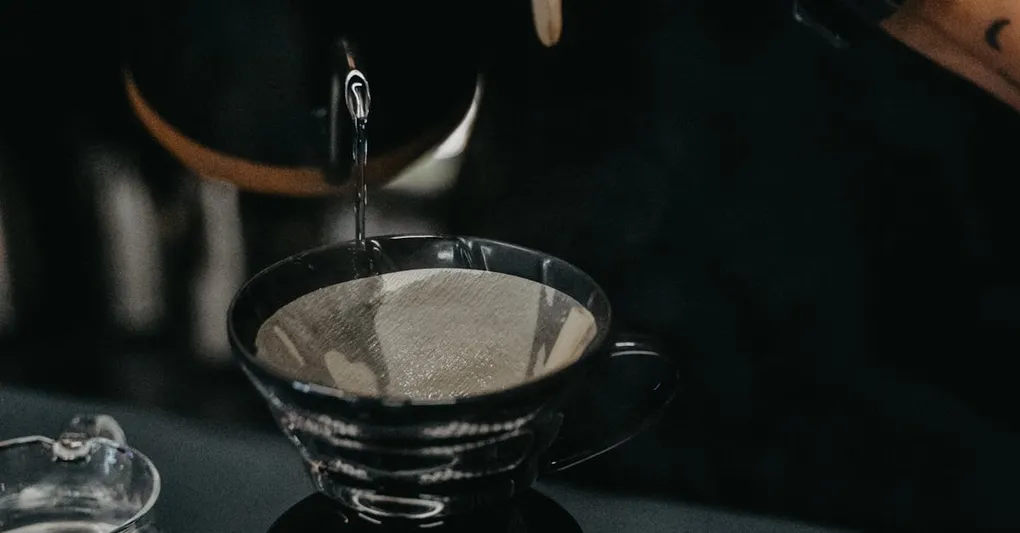
Pour over and French press are the two brewing methods most home brewers end up choosing between. They’re both manual. They’re both affordable. They’re both capable of producing genuinely excellent coffee. And they taste completely different from each other.
That’s not a styling difference or a matter of taste preference layered on top of an otherwise similar process. The physics of how each method extracts coffee are fundamentally distinct — and those physics directly determine what ends up in your cup.
Here’s what you actually need to know to decide which one belongs in your kitchen.
The Physics: Percolation vs Immersion
Everything that separates pour over from French press traces back to one difference in brewing mechanics.
Pour over is percolation. Water passes through a bed of coffee grounds once, then drains through a filter into your cup. The water is always moving, always relatively fresh, always maintaining a strong concentration gradient between itself and the grounds. This drives fast, efficient extraction — you’re constantly presenting the grounds with water that wants to dissolve more coffee solids. A typical pour over reaches 18-22% extraction yield in about 3-4 minutes.
French press is immersion. The grounds sit submerged in hot water for several minutes. As extraction proceeds, the water surrounding the grounds becomes increasingly concentrated. The driving force behind extraction — the difference in concentration between the grounds and the surrounding liquid — gradually shrinks. Extraction doesn’t stop, but it slows dramatically.
This is where a common misconception creeps in. You’ll sometimes hear that immersion brewing can only reach 16-19% extraction yield while pour over hits 18-22%. That’s not quite right. Peer-reviewed research (Liang, Chan & Ristenpart, 2021) shows that immersion brewing converges to roughly 20-22% extraction yield at equilibrium — comparable to pour over. The difference is time, not ceiling. Pour over gets there in 3-4 minutes because the water is always fresh. A standard 4-minute French press steep only reaches about 18-19% because the water has partially saturated. Extended methods — like the Hoffmann technique’s 10+ minute total contact time — push closer to 20-22%.
Neither approach is inherently better. But they produce profoundly different cups, and the reason has less to do with extraction yield than with what else comes through.
With pour over, you have continuous control over extraction through the entire brew: how fast you pour, where you pour, how you distribute water. Every variable you adjust changes the flavor in a predictable direction. With French press, the immersion environment does most of the work once you’ve set your variables — it’s more forgiving, but also less adjustable mid-brew.
There’s one more critical difference: the filter.
The Filter Is Everything
Paper filters and metal mesh filters don’t just trap different sizes of particles. They determine the fundamental character of your cup.
Paper filters (pour over) trap nearly all coffee oils — specifically the insoluble lipid compounds called diterpenes. They also catch micro-fines, the finest ground particles that pass through metal mesh. The result is a cup with very high clarity: individual flavors are distinct and easy to identify, acidity is bright and structured, and the texture is thin to medium-bodied.
Metal mesh filters (French press) let oils through. Those diterpenes — primarily cafestol and kahweol — carry significant aromatic compounds and create the velvety mouthfeel that French press is known for. The same filter also passes micro-fines into the cup, which add body and texture (and some sediment at the bottom).
Think of it this way: paper-filtered coffee is like looking at a painting through clean glass — you see every detail clearly. Metal-filtered coffee is like experiencing the painting in a warm room where you can smell the oils — less pristine, but richer and more enveloping.
The Health Distinction You Should Know
This filter difference isn’t just aesthetic. Cafestol and kahweol — the diterpenes that metal filters allow through — are documented LDL cholesterol-raising compounds. Paper-filtered coffee contains roughly 12 mg/L of cafestol. French press passes about 90 mg/L — roughly 7.5 times more.
To be clear: coffee’s overall health profile is overwhelmingly positive regardless of method. Studies consistently show reduced risk of type 2 diabetes, cardiovascular disease, and several cancers among regular coffee drinkers. But if you’re drinking 3+ cups of unfiltered coffee daily and already have elevated LDL, it’s worth knowing. Paper filters remove over 90% of these compounds. The paper filter in your pour over isn’t just a flavor preference — it has measurable metabolic consequences.
For most people, this won’t be a deciding factor. But it’s real science, not coffee mythology.
Cup Profile Comparison
Understanding what each method actually produces in the cup is more useful than abstract mechanics.
Pour Over: Clarity, Brightness, Complexity
Pour over coffee is clean. Whatever characteristics your coffee has — the specific fruit notes, the floral aromatics, the particular acidity from the origin and processing — pour over shows them to you with minimum interference. This is why specialty roasters and cafes often use pour over to showcase single-origin coffees — the paper filter strips away the background noise, letting the foreground flavors come forward.
Light roasts shine in pour over. The citrus acidity, stone fruit sweetness, and delicate aromatics of a naturally-processed Ethiopian or a washed Kenyan are easier to perceive when the cup is clear and bright. The texture is lighter — a clean, structured body rather than a heavy one.
The tradeoff: pour over is less forgiving. Small technique variations — pour rate, pour distribution, bloom timing — produce noticeable differences in the cup. It rewards attention.
French Press: Body, Richness, Integration
French press produces coffee that tastes integrated. The oils create a coherent, smooth mouthfeel. The full-bodied texture makes it feel more substantial. The flavors blend and meld rather than standing out distinctly.
This suits medium and dark roasts particularly well. The chocolate, caramel, and toasty notes of a Colombian or Brazilian coffee read as warmth and depth in a French press, where the body reinforces the flavors. A very light roast in a French press can taste flat or muddy — the complexity doesn’t have the clean water to express itself.
French press is also more forgiving. You can be 10 seconds off on your steep time or a few degrees off on water temperature and still produce an excellent cup. The immersion environment compensates for small inconsistencies.
Grind Size: Why Each Method Needs a Different Approach
The grind requirement for each method isn’t just a different setting on the same spectrum — the reasons for that setting are different.
French press needs coarse (like raw sugar or sea salt) for two reasons. First, the extended immersion contact time would severely over-extract a finer grind. Second, the metal mesh has visible gaps — fine particles pass right through and end up in your cup as sediment and grit. If your French press tastes muddy or overly bitter, grind coarser before adjusting anything else.
Pour over needs medium to medium-fine (like table salt) because the grind controls flow rate. The paper filter and the coffee bed together create resistance that slows the water. Too coarse and water blasts through in 90 seconds — underextracted, sour, thin. Too fine and the brew stalls into 6+ minutes — overextracted, bitter, astringent. You’re targeting a total brew time of roughly 3:00-4:00 for a V60 or similar single-hole cone dripper.
The other difference: burr grinder quality shows up more clearly in pour over. Because pour over is a percolation method, fines (the smallest particles any grinder produces) can cause channeling — water finds the path of least resistance through the bed rather than extracting evenly. This creates both over-extracted and under-extracted zones in the same brew. A better grinder with fewer fines produces more even extraction. For French press, fines matter less because immersion is inherently uniform — every ground is in the same water.
For a full breakdown of grind settings, see our coffee grind size guide.
Brewing: Side-by-Side Guide
Here’s how to brew each method well with the same coffee. We’re using a medium roast at a 1:15 ratio — 30g coffee to 450g water — for both methods to keep the comparison fair. Note that Hoffmann’s actual French press recipe uses a stronger 1:13.3 ratio (75g/L); we’ve normalized here so you can taste the method difference, not the ratio difference.
Pour Over (V60)
Grind: Medium-fine, like table salt Water temp: 91-96°C / 195-205°F — below boil Total time: ~3:00-4:00
- Rinse the paper filter with hot water, discard the rinse water. This removes paper taste and preheats the vessel.
- Add 30g ground coffee to the filter. Create a small well in the center.
- Pour 60g water (2x the coffee weight) in a slow spiral over the grounds. Wait 30-45 seconds while the bed blooms — CO2 escaping from fresh coffee pushes the grounds up. This is the bloom: it lets gas escape so water can contact grounds evenly.
- Pour the remaining 390g of water in slow, even circles over about 2 minutes. Keep the water level consistent — don’t let the bed drain completely between pours.
- Allow the bed to drain. Total brew time should be 3:00-4:00. If it’s faster, grind finer next time. If it’s slower, grind coarser.
For a deeper dive, see our complete pour over and V60 guide.
French Press (Hoffmann Method)
Grind: Coarse, like raw sugar Water temp: 95-100°C / 203-212°F — just off the boil Total time: ~10 minutes
- Add 30g coarse coffee to the press. Pour all 450g of water at once. Don’t stir.
- Wait 4 minutes. A crust of grounds will form on the surface.
- Stir the surface gently 3 times with a spoon to break the crust. Skim off foam and floating particles with two spoons — this removes what would become bitterness and grit.
- Place the lid on the press but do not push the plunger. Wait another 5-6 minutes. Grounds settle to the bottom naturally.
- Lower the plunger just below the liquid surface (don’t plunge fully). Pour slowly and deliberately. Leave the last half-inch — that’s sediment.
This counterintuitive long-wait method produces dramatically less grit and more clarity than the standard 4-minute-and-plunge approach. The extended steep also pushes extraction yield higher — closer to the 20-22% range that pour over achieves in a fraction of the time. For full technique detail, see our French press guide.
Cost Comparison
Equipment costs vary considerably based on quality level. Here’s an honest breakdown.
Pour Over — Entry Level (about $35-70) A Hario V60 ($12-20) plus a gooseneck kettle ($25-50) plus filters ($8 for 100). This gets you to an excellent cup. The gooseneck kettle is genuinely necessary for pour over — it lets you control exactly where and how fast water goes. A standard kettle works in a pinch but pour control suffers.
Pour Over — Serious Setup ($150-400) Add a Fellow Stagg EKG ($165) with precise temperature control, a quality burr grinder, and a coffee scale. See our coffee scale reviews for recommendations.
French Press — Entry Level ($25-50) A Bodum Chambord ($25-40) is genuinely excellent for the price. You can heat water in any kettle. No filters to buy. Lowest ongoing cost of any brewing method.
French Press — Serious Setup ($80-200) Upgrade to a Fellow Clara or Espro P6 (dual micro-filter significantly reduces sediment), add a quality burr grinder and scale.
The ongoing cost difference: Pour over requires filters — roughly $8-15 per 100, depending on brand. At one brew per day, that’s $30-55 per year in filters. French press has zero ongoing consumable cost beyond the coffee itself.
Who Should Buy Which
Buy a pour over if:
- You like light or medium-light roasts and want to taste the origin character
- You want the cleanest, most detailed cup possible
- You’re interested in the process and enjoy the ritual of technique
- You’re brewing for one person and want precision
- You have LDL cholesterol concerns and prefer paper-filtered coffee
- You already own a good gooseneck kettle (or want one)
Buy a French press if:
- You prefer medium to dark roasts and want richness over brightness
- You want the simplest, most forgiving manual method
- You’re often brewing for 2+ people (scale-up is trivial — pour more water)
- You want zero ongoing consumable cost
- You prefer a robust, full-bodied cup over a delicate, complex one
- You make coffee early in the morning and don’t want a fussy process
The flavor preference test: Think about how you feel about drip coffee versus a rich, full-bodied cup. If you’ve had both a V60 pour over and a well-made French press and you know which you preferred, that’s your answer. If you don’t know, try both at a good coffee shop before buying anything.
If You Can Only Own One
My recommendation: start with a French press.
It’s cheaper, more forgiving, produces an excellent cup without much learning curve, and reveals whether you actually enjoy the hands-on brewing process before you invest in a kettle, scale, and technique practice that pour over requires. A $30 Bodum and any grinder that produces a coarse grind will make genuinely excellent coffee.
If you brew your French press daily for a few months and find yourself wanting more clarity, more origin character, more control over the cup — then you’re ready for pour over. The two methods complement each other rather than compete: French press for mornings when you want warmth and body, pour over for afternoons when you want to taste what the coffee actually is.
The one exception: if you already know you love light, complex, origin-forward coffee — the kind you’ve had at a specialty cafe and thought “why doesn’t my coffee taste like this?” — skip the French press and go directly to pour over. That’s the tool for that style of cup.
Frequently Asked Questions
- Does pour over actually taste better than French press?
- Neither is objectively better — they produce fundamentally different cups. Pour over delivers more clarity, brightness, and origin character. French press delivers more body, richness, and integrated flavor. The better question is which style you prefer. Light roast fans typically prefer pour over. Those who want a robust, full-bodied cup lean toward French press. Try both at a good coffee shop before deciding.
- Is French press bad for you compared to pour over?
- French press passes diterpene compounds (cafestol and kahweol) that paper-filtered pour over removes. Paper-filtered coffee contains roughly 12 mg/L of cafestol; French press passes about 90 mg/L. Paper filters remove over 90% of these LDL cholesterol-raising compounds. For most people drinking 1-2 cups daily, this difference is negligible. If you drink 3+ cups daily and have cholesterol concerns, the paper filter in pour over is a meaningful health advantage.
- Can I use the same coffee beans for both methods?
- Yes — the same bag of beans can be brewed with either method. What changes is the grind size and what the cup tastes like. The same medium roast Ethiopian might taste bright and floral in a pour over and smooth and nutty in a French press. Generally, light roasts show more of their distinct character in pour over. Medium to dark roasts translate well to both methods, but particularly shine in French press where the heavier body suits those roast profiles.
- Do I need a special kettle for pour over?
- A gooseneck kettle is strongly recommended for pour over. It lets you control exactly where water goes and how fast — critical for even extraction across the coffee bed. A standard kettle produces an uncontrolled splash that disturbs the grounds and causes uneven extraction. For French press, a standard kettle works perfectly fine since you're just adding water to a vessel, not pouring with precision.
- Which method is easier to learn?
- French press is significantly more forgiving. You add coffee, add water, wait, and pour. Grind size and water temperature matter, but small errors don't ruin the cup. Pour over has a learning curve around pour control, bloom timing, and maintaining consistent water level — small technique variations produce noticeable flavor differences. For beginners, French press is the lower-stress starting point.
- What grind do I use for pour over versus French press?
- Pour over needs medium-fine — similar to table salt in texture. French press needs coarse — similar to raw sugar or sea salt. The difference isn't arbitrary: pour over's grind controls flow rate through the paper filter, while French press's coarse grind prevents over-extraction during the long immersion steep and keeps particles large enough not to pass through the metal mesh. See the grind size guide for detailed settings by brewer.
- Which method is better for making coffee for multiple people?
- French press scales up trivially — just increase coffee and water proportionally. A 34oz French press serves 2-4 people at once. Pour over is designed for single servings; brewing multiple consecutive cups takes time and technique. If you regularly make coffee for a group, French press (or a large Chemex) is the more practical choice.
- Does French press have more caffeine than pour over?
- Not significantly. Both methods extract similar amounts of caffeine from the same dose of coffee. Pour over runs slightly higher extraction efficiency in a shorter time, but in practice the ratio of coffee to water matters far more than the brewing method. Use the same dose and ratio and you'll get essentially the same caffeine content. For a full breakdown, see our caffeine guide.
Some links above are affiliate links. If you buy through them, we earn a small commission at no extra cost to you. We only recommend products we’d actually use.