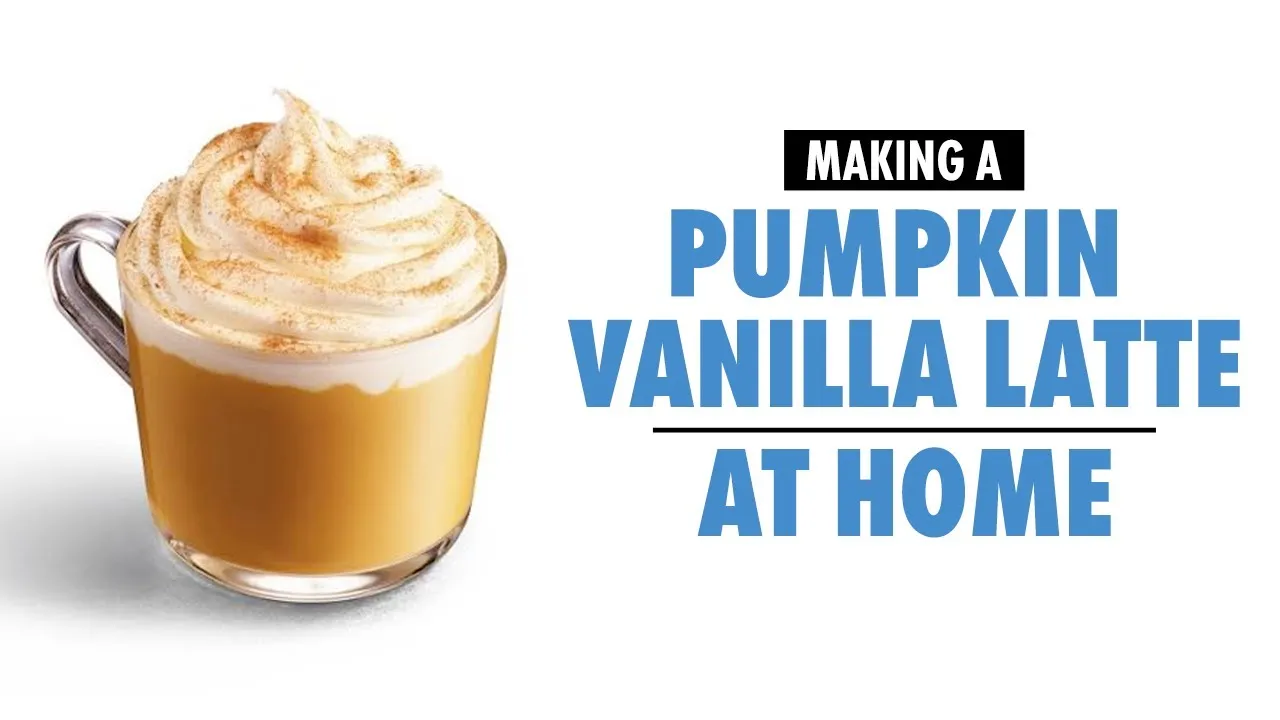
This is our pumpkin vanilla latte: a regular latte with real pumpkin and a vanilla syrup heated into the milk, and a homemade pumpkin pie spice on top. It’s ours, not a copy of any coffee shop’s recipe; how Starbucks makes its Pumpkin Spice Latte is further down, from Starbucks’ own pages.
Our October 2019 video makes everything on this page from scratch: the vanilla syrup, a roasted pumpkin puree, the spice blend and the latte. The amounts below are the ones on its cards. It predates this revision, so the storage times and milk temperatures here come from the sources named on this page.
The latte
For one latte:
- Whole milk: 1 cup (about 240 ml, 244 g).
- Pumpkin puree: 1½ tablespoons (about 23 g), homemade or canned.
- Vanilla syrup: 2 tablespoons (30 ml).
- Pumpkin pie spice: ¼ teaspoon, plus a pinch to finish.
- Espresso: 2 shots, a double, which our Brew Guide makes as about 36 g from 18 g of coffee.
- Makes: about 11 US fl oz (about 325 ml) before the foam, calculated from the volumes above.
- Time: about 5 minutes once the syrup and puree are made.
Method:
- Put the milk, pumpkin puree, vanilla syrup and ¼ teaspoon of pumpkin pie spice in a small saucepan.
- Heat it on medium-low for 2 to 3 minutes, stirring, until hot and steaming, without letting it boil.
- Take the pan off the heat and whisk hard until the milk is foamy.
- Pull 2 shots of espresso into a mug or heatproof glass.
- Pour the foamed pumpkin milk over the espresso.
- Dust the top with a pinch of pumpkin pie spice.
How hot? If you have a thermometer, the figures for steamed milk are a useful guide in a saucepan too. Breville’s Bambino manual has milk ready at 140–149°F (60–65°C). James Hoffmann writes that milk begins to deteriorate in flavor and texture above 154°F (68°C), and that he finds milk heated to 140°F (60°C) better in sweetness and texture than very hot milk. Scott Rao’s café target is 150–160°F (66–71°C), and the top of that is past Hoffmann’s limit. Whichever you follow, take the pan off before the milk simmers. If you’d rather use a steam wand, our milk steaming guide has the method; you can stir the puree, syrup and spice into the espresso and steam the milk on its own.
No espresso machine? A moka pot makes a strong, small coffee that stands in for the shots; our moka pot guide shows how. The latte will taste a little different, since moka coffee isn’t espresso.
The vanilla syrup
Our video makes its own:
- Water: ½ cup (118 g).
- Sugar: ½ cup (100 g).
- Vanilla bean: 1, split lengthwise, with the seeds scraped out.
Heat the water and sugar in a small saucepan, stirring, until the sugar dissolves and the syrup comes to a simmer. Add the vanilla seeds and the split bean, let it simmer briefly, then take it off the heat and let it cool. Pour it into a clean jar. It starts as about 218 g of water and sugar, enough for several lattes at 2 tablespoons each. A bought vanilla syrup works the same way in the recipe.
USDA’s FoodKeeper has no entry for homemade syrup, so we don’t give it a shelf life. Keep it covered in the fridge, make small batches, and follow the FDA’s rule: “If you’re not sure or if the food looks questionable, throw it out.”
The pumpkin puree
The video roasts a whole small pumpkin:
- Cut the pumpkin in half, scoop out the seeds and cut it into chunks.
- Spread the chunks on a lined baking tray and bake them for 45 minutes at 400°F (204°C), until soft.
- Peel off the skins.
- Process the flesh until smooth.
The shortcut is a can, as long as it’s plain pumpkin. Libby’s describes its 100% Pure Pumpkin as “pure pumpkin with nothing added,” while its Easy Pumpkin Pie Mix comes with “the ideal blend of spices and sugar” for pie. Use the plain one, so the syrup and spice set the sweetness.
Keeping it. A latte uses only 1½ tablespoons, so most of the puree waits in the fridge:
- Homemade puree is a cooked food, and USDA’s guidance for cooked leftovers is 3 to 4 days in the refrigerator, or 3 to 4 months in the freezer for best quality (frozen food stays safe indefinitely, but loses flavor and moisture with time).
- Opened canned pumpkin: USDA lists pumpkin among low-acid canned goods, which keep 3 to 4 days in the refrigerator once opened.
Freezing the leftover puree in tablespoon portions, in an ice cube tray, lets you thaw just what one latte needs.
The pumpkin pie spice
The video mixes its own blend:
- 2 tablespoons ground cinnamon
- 2 teaspoons ground ginger
- ¼ teaspoon ground nutmeg
- ⅛ teaspoon ground cloves
Stir them together and keep the blend in a closed jar. USDA’s FoodKeeper gives ground spices 2 to 3 years in the pantry for best quality. A bought pumpkin pie spice works too.
How Starbucks’ Pumpkin Spice Latte compares
Where it comes from. Starbucks says a small team developed the drink in its “Liquid Lab” in 2003, after sampling a forkful of pumpkin pie followed by a sip of espresso to see which flavors went with coffee. It first tested the Pumpkin Spice Latte on October 10, 2003, in about 100 stores in Vancouver, British Columbia, and Washington, D.C., and rolled it out across the US and Canada the following fall. The first recipe, in Starbucks’ words, used “pumpkin spice sauce with cinnamon, clove and nutmeg,” espresso and steamed milk, with whipped cream and pumpkin pie topping.
Is there pumpkin in it? Since 2015, Starbucks says, the sauce has included “real puree made from small kobucha pumpkins grown in Walla Walla Valley.”
What’s in it now. Checked on Starbucks’ US menu on October 18, 2026, a Grande (16 fl oz) Pumpkin Spice Latte has 2 shots of Signature Espresso, 2% milk by default, 4 pumps of pumpkin spice sauce, whipped cream and a pumpkin spice topping. The sauce lists sugar, condensed skim milk and pumpkin puree first, then 2% or less of fruit and vegetable juice for color, natural flavors, annatto, salt and potassium sorbate. The topping is cinnamon, ginger, nutmeg and cloves. A Short or Tall has 1 shot; a Venti, 2. For 2026, Starbucks brought the drink back with its fall menu on August 25.
| Starbucks PSL, Grande | Our latte | |
|---|---|---|
| Size | 16 fl oz cup | About 11 fl oz before foam |
| Espresso | 2 shots | 2 shots |
| Milk | 2% by default, steamed | 1 cup whole milk, heated and whisked |
| Pumpkin and sweetener | 4 pumps of sauce made with sugar, condensed skim milk and pumpkin puree | 1½ tbsp pumpkin puree and 2 tbsp vanilla syrup |
| Spice | Topping of cinnamon, ginger, nutmeg and cloves | The same four spices, in the milk and on top |
| Topping | Whipped cream | None |
| Caffeine | 150 mg, per Starbucks | About 120–150 mg, per our Caffeine Calculator |
Starbucks’ details are from its menu and its own history pages; the comparison is ours.
Iced, and other swaps
- Iced. Whisk or shake the cold milk with the puree, syrup and spice until smooth, pour it over ice, and add the espresso. Stir before you drink it, since the pumpkin settles.
- Dairy-free. Use a plant milk made for steaming. In one lab comparison of six plant milks, oat, pea and soy foamed best when frothed hot; our plant milk guide and oat milk comparison cover the details.
- Less sweet. Cut the vanilla syrup to 1 tablespoon, and taste before adding more.
For more drinks in the same spirit, try our caramel brûlée latte, our homemade coffee creamer, whose video notes include a pumpkin spice version, or the spiced coffee guide.
Sources
- JayArr Coffee, “Making a Pumpkin Vanilla Latte at Home!”, YouTube, October 2, 2019 (the recipe and amounts on the video’s cards): youtube.com
- Starbucks, “Pumpkin Spice Latte,” history page (the Liquid Lab in early 2003, the pumpkin pie and espresso tasting, the first recipe, the 100-store test, the 2004 US rollout), checked October 18, 2026: about.starbucks.com
- Heidi Peiper, “Happy birthday, PSL!”, Starbucks Stories, October 2, 2026 (the October 10, 2003 test in Vancouver and Washington, D.C.; the US and Canada launch the following autumn; real pumpkin puree since 2015): about.starbucks.com
- Starbucks Stories, “Starbucks announces the return of Pumpkin Spice Latte (PSL) Aug. 25, new Chaider and more fall favorites,” August 3, 2026: about.starbucks.com
- Starbucks, “Pumpkin Spice Latte,” US menu, product 418 (description, sizes, default recipe by size, ingredients and the Grande’s 150 mg of caffeine, read from the menu’s public product data), checked October 18, 2026: starbucks.com
- Breville, the Bambino (BES450) Instruction Book, US edition, p. 13 (“Manual Milk Texturing”): breville.com (PDF)
- James Hoffmann, The World Atlas of Coffee, revised edition (Mitchell Beazley, 2018), p. 108, “Steaming Milk”
- Scott Rao, The Professional Barista’s Handbook (2008), p. 46, “Milk Steaming Goals”
- Libby’s, “100% Pure Pumpkin” and “Easy Pumpkin Pie Mix” product pages, checked October 18, 2026: verybestbaking.com and verybestbaking.com
- USDA FoodData Central, “Pumpkin, canned, without salt,” SR Legacy, FDC ID 168450 (1 cup = 245 g), and “Milk, whole, 3.25% milkfat, with added vitamin D,” FDC ID 171265 (1 cup = 244 g), and “Sugars, granulated,” FDC ID 169655 (1 cup = 200 g), checked October 18, 2026: fdc.nal.usda.gov
- USDA Food Safety and Inspection Service, “Leftovers and Food Safety,” last updated July 31, 2020 (3 to 4 days refrigerated, 3 to 4 months frozen): fsis.usda.gov
- USDA Food Safety and Inspection Service, “Shelf-Stable Food Safety,” last updated October 24, 2024 (storage chart: low-acid canned goods, including pumpkin, 3 to 4 days in the refrigerator after opening): fsis.usda.gov
- USDA Food Safety and Inspection Service, FoodKeeper data, version 128 (September 6, 2018), entry for “Spice/spices, ground,” retrieved October 18, 2026: fsis.usda.gov
- US Food and Drug Administration, “Are You Storing Food Safely?”, consumer update, content current as of January 18, 2023: fda.gov
- Lena Hassan and colleagues, “The bubbly life and death of animal and plant milk foams,” Soft Matter 20, no. 41 (2024): 8215–8229, abstract: doi.org/10.1039/d4sm00518j