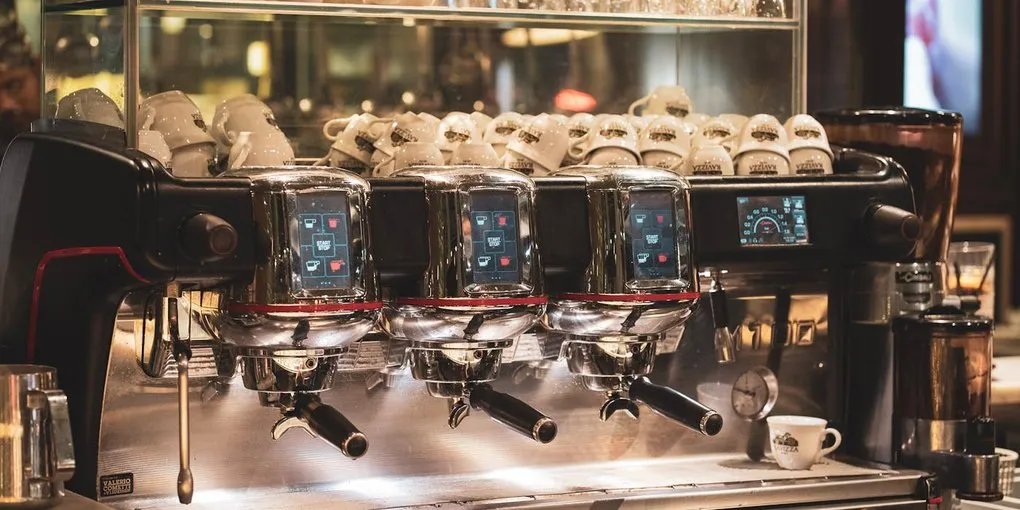
Walk into a traditional Italian bar and order an espresso. You will get a shot pulled from 6.5 to 7 grams of coffee, brewed at 185 to 195 degrees Fahrenheit, yielding about one ounce of liquid in a demitasse. Walk into a third-wave American coffee shop and order an espresso. You will get a shot pulled from 18 to 21 grams of coffee, brewed at 195 to 203 degrees Fahrenheit, yielding roughly 36 to 42 grams of liquid. The cup will taste completely different — and not because one is “better” and the other is “worse.” They are executing different philosophies with different goals.
Understanding the differences requires getting into the physics of dose, temperature, and extraction. This is not a cultural preference article. It is a technical one. For how to actually dial in either style, see how to dial in espresso. For the science of what extraction yield means and why it matters, see our extraction yield guide. And for equipment recommendations, check our best espresso machines under $500.
The Dose Difference Is Larger Than You Think
The most fundamental difference between Italian and American espresso is the dose — the amount of dry coffee in the portafilter basket.
Italian traditional: 6.5 to 7 grams for a single, 13 to 14 grams for a double. This has been the standard in Italian cafes for decades.
American third-wave: 18 to 21 grams, typically yielding a “double” that is really a triple by Italian standards. Some specialty shops push to 22 grams.
That is a three-fold difference in dry coffee mass for what both cultures call “an espresso.” The consequences cascade through every variable.
Why Dose Changes Temperature Requirements
Larger doses require higher brew temperatures to achieve the same extraction temperature inside the coffee puck. This is not preference — it is physics.
When hot water hits the coffee bed, the water loses heat to the grounds. A larger mass of coffee absorbs more heat. Scott Rao documented this relationship: a 21-gram dose at 203.5 degrees Fahrenheit produces the same equilibrium temperature as a 7-gram dose at 190.5 degrees Fahrenheit. That is a 13-degree spread driven entirely by the thermal mass of the coffee bed.
This explains a common misconception. Italian espresso is often described as “lower temperature” — and the brew temperature at the group head is indeed lower, typically 185 to 195 degrees Fahrenheit. But the coffee itself reaches a similar temperature range during extraction because there is less coffee to steal heat from the water.
American third-wave espresso runs the group head at 195 to 203 degrees Fahrenheit not because Americans prefer hotter coffee, but because the larger dose demands higher water temperature to achieve adequate extraction. Without it, the center of the puck underextracts while the edges overextract, producing a shot that is simultaneously sour and bitter. For more on why uneven extraction creates this specific problem, see our guide to fixing channeling and uneven extraction.
Basket Geometry and Puck Depth
The physical shape of the portafilter basket differs between styles, and this matters more than most people realize.
Traditional Italian single baskets have a truncated cone shape — narrower at the bottom than the top. Rao notes that this shape actually produces more uniform extraction than cylindrical double baskets, because the cone compensates for the inherent advantage that upper layers of coffee have (they contact more dilute, hotter water first).
American-style double and triple baskets are cylindrical, holding the larger 18 to 22 gram doses. The deeper coffee bed means longer water contact time and higher total extraction potential — but also greater risk of channeling. Rao recommends keeping doses within 10% of the basket’s rated capacity to maintain consistent puck depth and resistance. The 18 to 21 gram doses preferred by third-wave baristas in properly sized baskets provide thick enough pucks to channel less.
Smaller diameter baskets (52mm versus 58mm) produce a deeper bed at the same dose weight, which increases laminar resistance and promotes more uniform extraction. Some of the interest in smaller portafilter systems is driven by this physics — not just convenience.
Extraction Targets and Ratios
The styles differ in their target extraction yields and brewing ratios, though they share more common ground here than the dose difference might suggest.
Italian approach: The traditional ratio for a single is roughly 1:2 by volume — 7 grams in, about 30 milliliters out. Measured by weight (which is more precise because crema inflates volume readings), this works out to approximately 14 grams of liquid from 7 grams of coffee, or a 1:2 mass ratio.
American approach: The standard is also approximately 1:2 by weight — 18 grams in, 36 grams out. Rao’s definitions:
| Style | Ratio (dry coffee to liquid) | Example |
|---|---|---|
| Ristretto | 60-140% | 21g dose yielding 21g liquid |
| Normale | 40-60% | 7g dose yielding 14g liquid |
| Lungo | 27-40% | 7g dose yielding 21g liquid |
Both traditions target the 1:2 ratio as a starting point. The difference is what happens around that ratio. Italian espresso tends to stay closer to ristretto territory — shorter, more concentrated shots that prioritize body and intensity. American specialty espresso has been pushing ratios longer, sometimes into 1:2.5 or 1:3 territory, chasing higher extraction yields that reveal more origin character and complexity at the expense of body.
The target extraction yield for a well-pulled espresso is approximately 19 to 20%, regardless of style. Shot time ranges from 20 to 35 seconds for traditional flat-pressure profiles and can extend to 25 to 40 seconds with pressure profiling. For the full breakdown of how strength and extraction yield interact, see coffee strength vs extraction.
The Blend Question
Italian espresso blends frequently include Robusta — often 10 to 40% alongside Arabica. This is not a cost-cutting measure. It is a deliberate flavor and textural choice.
Robusta contributes thicker, more stable crema. It adds body and the bitter-chocolate backbone that defines classic Italian espresso. It also adds caffeine — Robusta contains roughly double the caffeine of Arabica (1.7 to 4.0% versus 0.8 to 1.4%). For more on Robusta’s role in espresso and its emerging quality story, see our piece on Arabica vs Robusta.
American third-wave espresso overwhelmingly uses 100% Arabica, often single-origin coffees roasted lighter than Italian tradition. The goal is to express the specific character of a particular farm, variety, and processing method — acidity, fruit notes, floral aromatics. These flavors are delicate and can be masked by Robusta’s assertive bitter-chocolate profile. For how roast level shapes these flavor differences, see coffee roast levels explained.
Neither approach is wrong. They are optimizing for different outcomes. The Italian approach prioritizes consistency, body, and crema across a high-volume cafe environment. The American approach prioritizes origin transparency and flavor complexity in a specialty context.
Crema: Cultural Divides
Crema holds near-sacred status in Italian espresso culture. A thick, persistent, tiger-striped crema is a sign of freshness, proper extraction, and quality. Italians will reject a shot that lacks adequate crema.
The specialty coffee perspective is more ambivalent. James Hoffmann notes that crema actually tastes quite bitter and ashy on its own — it is primarily CO2 and water vapor bubbles wrapped in surfactant films. He advises skimming crema off an americano for a better drink. Rao adds that an americano tastes more bitter than the espresso it was made from because adding water dilutes the oil content that coats the tongue and masks bitterness.
Crema is a reliable indicator of freshness (fresh beans outgas more CO2) but is not a reliable indicator of quality. A terrible espresso from fresh beans will have gorgeous crema. A great espresso from beans that are three weeks post-roast may have modest crema.
The functional difference: Italian-style blends with Robusta produce more crema. Lower-fines espresso from specialty flat-burr grinders (like SSP ultra-low fines burrs) produces minimal or no crema because fine particles are what stabilize crema’s foam structure. The very grinder technology that the specialty world celebrates for clarity and extraction undermines the visual marker that Italian tradition prizes. For more on how burr geometry shapes flavor and crema, see conical vs flat burr grinders.
Shot Assessment: Volume versus Weight
How you know when a shot is done reveals a deep philosophical split.
Italian tradition: Assess by volume. A single espresso fills a demitasse to a certain visual level. The barista watches the stream and cuts it based on appearance and timing.
American specialty: Assess by weight. A precision scale under the cup reads 36.0 grams and the barista stops the pump. Rao demonstrates why this matters: fresh beans produce far more crema, inflating the visual volume of a shot. A 30-gram shot from fresh beans can appear to be nearly 60 milliliters in volume due to crema expansion, while the same weight from 15-day-old beans barely exceeds 30 milliliters. A barista who stops shots by visual volume systematically underextracts fresh roasts — pulling less liquid because the cup looks full.
This creates a double penalty. Fresh beans already force a coarser grind (more CO2 means more back-pressure in the puck). Stopping the shot early by visual volume means the already-coarser grind produces even less extraction. Rao argues that baristas who rely on visual volume overestimate the flavor benefit of resting beans — much of the perceived improvement over the first week is simply that shots get longer as the beans degas. For the complete science of how freshness affects espresso, see coffee freshness: roast to stale.
The practical recommendation from both traditions: always measure espresso by mass, not volume.
The Preinfusion Split
Preinfusion — wetting the coffee puck at low pressure before full extraction pressure — is standard in American specialty espresso but has a different history in Italian practice.
Traditional Italian machines, particularly lever machines like La Pavoni, inherently provide preinfusion as the lever is engaged. The puck sees low pressure as water fills the headspace, then full pressure during the pull. E61 group heads also provide a form of passive preinfusion. Italian espresso has always had some preinfusion — it was just not named or optimized as a separate variable.
American specialty has made preinfusion an explicit, measurable, and optimizable phase. Machines like the Decent DE1 allow programmable preinfusion duration, pressure ramp rate, and even a post-preinfusion pause. Rao’s three-phase pressure profiling model — 10 to 12 seconds of preinfusion, 6 to 9 seconds of full pressure, then 15 to 18 seconds of declining pressure — represents the current peak of this optimization.
The practical benefit: preinfusion reduces channeling by allowing grounds to swell and redistribute before full pressure compacts the bed. Rao describes it as not necessarily making the best shot better, but making great shots happen much more frequently.
For the complete guide to dialing in espresso — dose, grind, temperature, ratio, timing — see how to dial in espresso. For the differences between ristretto, normale, and lungo shot styles, see what makes ristretto and lungo different. And for the broader comparison with drip brewing, see espresso vs drip coffee.
Frequently Asked Questions
- Which style of espresso has more caffeine?
- American-style espresso uses roughly three times the coffee dose (18-21g versus 6.5-7g), so it delivers significantly more caffeine per shot. However, Italians often drink multiple espressos throughout the day, and Italian blends frequently include Robusta (1.7-4.0% caffeine versus Arabica's 0.8-1.4%), which narrows the per-shot gap somewhat. The total daily caffeine intake depends more on consumption pattern than on any single shot.
- Can I pull Italian-style shots on my home espresso machine?
- Most home machines with 58mm portafilters come with both single and double baskets. The single basket (designed for 7-8g doses) is where Italian-style shots happen. Single baskets can be less forgiving of distribution errors due to the shallower puck. If you want to try Italian-style dosing, use the factory single basket, dose 7g, target a 1:2 ratio (14g out), and brew at 200 degrees Fahrenheit or slightly below. The shot will be smaller, more concentrated, and less acidic than a third-wave double.
- Why do Italian cafes serve espresso so much faster than American specialty shops?
- Italian cafe workflow is designed for speed and volume. The espresso machine runs continuously, the grinder is dialed in once at the start of the day (or when beans change), and the barista works by feel and timing rather than weighing each shot. With a 7g single dose, a skilled Italian barista can serve an espresso in under 60 seconds from order to demitasse. American specialty shops weigh the dose, distribute with a WDT tool, tamp precisely, weigh the output, and may time the shot — each step adding seconds. The trade-off is consistency and precision at the cost of throughput.
- Is third-wave espresso actually better than traditional Italian espresso?
- They optimize for different things. Third-wave espresso prioritizes origin transparency — you should taste the specific farm, variety, and processing method. Traditional Italian espresso prioritizes consistency, body, and the ritual experience — a perfect complement to a pastry at a standing bar. Judging one by the other's criteria produces nonsensical conclusions. Both are good espresso for their intended context.