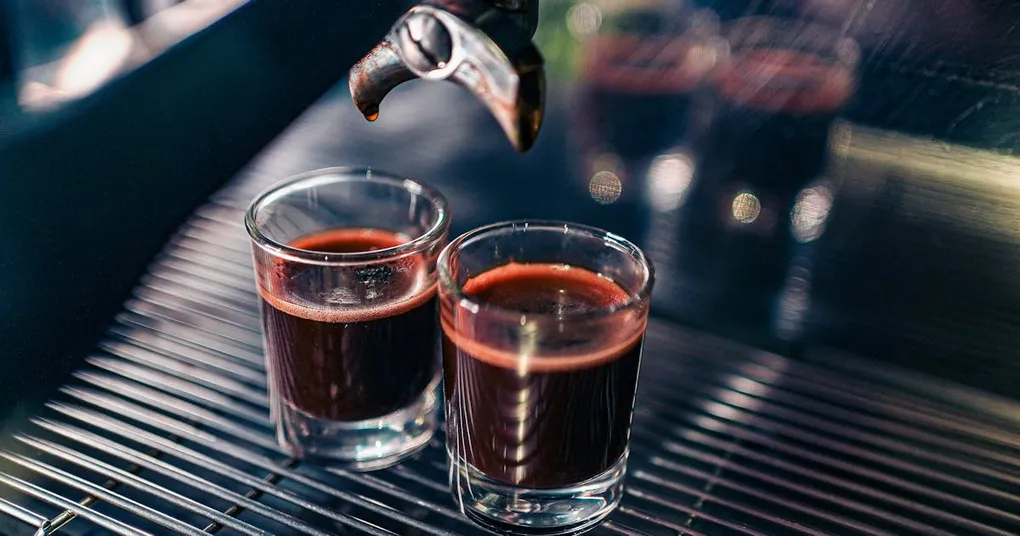
Dialing in espresso means finding the specific combination of grind size, dose, yield, and time that produces the best shot your coffee can make. Every variable affects every other variable. New beans require a new dial-in. A humidity change in the room can shift your grind setting by a notch. You don’t find the perfect shot once and lock it in forever — you understand the system well enough to read a shot, diagnose what’s wrong, and make the right adjustment.
This guide covers the beginner workflow, the science behind each parameter, what your shot is telling you, and the counterintuitive research that challenges some standard advice.
The Five Parameters
Espresso extraction is controlled by five variables. Four you adjust routinely. One is mostly fixed by your machine.
1. Pressure: 8-9 bars This is largely determined by your machine. Standard espresso targets 9 bars at the puck, which is the established optimum for the combination of dissolved solids, emulsified oils, and CO2 retention that defines espresso. Modern machines are often set to 9 bars from the factory; some allow pressure profiling (variable pressure over the shot). For home brewers on standard machines: pressure is not what you’re adjusting day to day.
2. Temperature: 185-204°F / 85-96°C Higher temperatures extract more efficiently — specifically, they unlock compounds that dissolve poorly at lower temperatures. The practical home range is 90-95°C for most coffees. Light roasts benefit from higher temperatures (92-96°C) because their denser structure resists extraction; dark roasts are often pulled at the lower end (88-92°C) because they extract freely and can over-extract at higher temperatures. See the full brewing temperature guide for the extraction chemistry behind these numbers.
3. Time: 20-35 seconds The shot clock starts when water reaches the puck, not when you press the button. A standard single espresso should complete in 20-35 seconds; most specialty coffee targets 25-30 seconds for a 1:2 ratio. Time is a diagnostic output more than an input — you don’t set time directly, you adjust other variables and observe what the time becomes.
4. Dose: 6.5-21g Dose is the weight of dry ground coffee in the portafilter basket. The range is wide because baskets come in different sizes — single (6.5-9g), double (14-21g), and various “ridgeless” modern baskets that allow different dose ranges. For most home setups with a standard double basket, 18g is a common starting point. Measure this with a 0.1g resolution scale — volume is not reliable for coffee because grind density varies.
5. Yield (Output): 1:2 ratio by weight as default Yield is the weight of liquid espresso in the cup. The standard starting ratio is 1:2 — for every gram of coffee in, target two grams of coffee out. An 18g dose targets 36g yield. This ratio defines what “espresso” is in contemporary specialty coffee; it is not the only ratio, but it is the correct starting point for dialing in.
The Beginner Workflow
This sequence solves most dialing-in problems for home baristas who are new to espresso. It doesn’t require experience — it requires a scale and the willingness to taste and adjust.
Step 1: Weigh 18g into the basket. Use a scale accurate to 0.1g. Eyeballing dose is a meaningful source of shot variation. Consistency here is foundational.
Step 2: Use a WDT tool before tamping. WDT (Weiss Distribution Technique) uses a thin wire or needle to rake through the grounds in the basket, breaking up clumps that form during grinding. Clumps create uneven density in the puck, which creates channels where water flows preferentially — the primary cause of uneven extraction. A WDT tool costs $10-20 and dramatically improves extraction consistency on most setups.
Step 3: Tamp level and consistent. Place the portafilter on a flat surface. Lower the tamper until it meets the grounds and press straight down until resistance is firm. Target approximately 15-20 lbs of pressure — but the critical variable is levelness, not force. A tilted tamp creates a wedge-shaped puck that channels water toward the thin side. If you’re not confident in your leveling, a self-leveling tamper ($30-80) removes the human variable entirely.
Step 4: Target 36g out in 25-30 seconds. Place the cup on the scale before pulling. Start the shot and start the timer simultaneously. When the scale reads 36g, stop the shot. Note the time.
Step 5: Taste and adjust. This is the irreplaceable step. Drink a small amount of the shot — even if it doesn’t seem ready — and use what you taste to diagnose the next adjustment.
Tasting Your Way to the Right Shot
The flavor tells you exactly what to do next. There are three basic states:
Sour / thin / sharp / astringent with fast time (under 20 seconds) Grind finer. Sourness in espresso almost always indicates under-extraction — not enough dissolved material in the cup. Fine-grinding increases surface area and slows water flow through the puck, allowing more extraction in the same time frame.
Bitter / harsh / dry with slow time (over 35 seconds) Grind coarser. Bitterness and excessive dryness (astringency in a different register than sour astringency) indicate over-extraction — too much dissolved material, including the bitter compounds that extract last. Coarser grinding speeds flow and reduces extraction.
Watery / flat / thin but on-time Adjust dose or yield, not grind. If time is correct but flavor is thin, try increasing dose (19-20g) or reducing yield (target 30-32g instead of 36g) to concentrate what’s there.
Balanced / sweet / complex You’re in range. Fine-tune grind by single increments to optimize.
One variable at a time. Changing grind and dose simultaneously makes diagnosis impossible — you don’t know which change produced the result. Change one variable, pull one shot, taste, decide the next step.
What Rao Says About Tamping
Scott Rao’s tamping research is the most important single reframe for home baristas who overthink this step.
The pump exerts roughly 533 lbs of force on the coffee puck. A barista applying 30-50 lbs of hand pressure is contributing less than 10% of the total compression force the grounds will experience. That asymmetry means additional tamping pressure — beyond the minimum needed to eliminate void spaces and create a flat, level surface — is effectively irrelevant to extraction.
Once you’ve eliminated air gaps with firm, level contact, additional force changes nothing. The pump will compress the puck far beyond anything your wrist can provide.
What Rao recommends:
- Tamp lightly but firmly until resistance is felt and void spaces are closed
- Never twist the tamper on the way up — no “polish.” Twisting can disrupt the top layer of grounds without providing any benefit
- Never do a “second tamp” after the first — it doesn’t add additional compression; it just wastes time and can introduce tilt
- Level surface is the goal. That’s all tamping needs to accomplish.
The Tap Rule: Do Not Tap the Portafilter
Many home baristas tap the side of the portafilter between tamps, following what they’ve seen in cafes or videos. Rao is explicit: do not do this.
Tapping the portafilter side fractures the seal between the grounds and the basket wall. This creates a gap at the perimeter that water exploits, flowing around the outside of the puck rather than through it. Once this gap exists, it cannot be fixed by additional tamping. The result is channeling — water racing through the path of least resistance and under-extracting the bulk of the puck. Use WDT to level the grounds before tamping; tap nothing after.
Preinfusion: The Most Underrated Variable
Preinfusion means running low-pressure water (typically 3.5-4.5 bar) through the puck for a few seconds before ramping to full extraction pressure (9 bar).
Rao describes preinfusion precisely: “will not necessarily make the best shot better, but will result in a much higher frequency of great shots.” This is the correct framing for home baristas. Preinfusion doesn’t magically improve every cup — it reduces the variance of outcomes by doing two things:
1. Decreases channeling: Low-pressure water gradually wets the puck and creates more uniform density before the full pressure surge hits. An uneven puck subjected to immediate 9-bar pressure channels before the grounds can redistribute. A pre-wetted puck channels less because pressure is applied to already-saturated, more-uniform grounds.
2. Reduces fines migration: Fine coffee particles (“fines”) migrate toward the filter basket under pressure and can clog it, restricting flow and causing pressure backup. Low-pressure preinfusion allows the puck to expand and seal more gradually, reducing the pressure differential that drives fines migration.
Target: 3.5-4.5 bar for 3-10 seconds before ramping to full pressure. Many machines include preinfusion settings; if yours doesn’t, some baristas simulate it by briefly activating the pump at partial throttle.
Hendon’s Research: The Case for Fewer Grams
In 2020, physicist Christopher Hendon published a paper in Matter that challenged standard espresso practice. His finding: fine-grinding espresso creates inhomogeneous channels in the puck, leading to poor shot-to-shot reproducibility. His recommendation was counterintuitive — use fewer grams of coffee, a slightly coarser grind, and pull shorter shots.
Specifically, Hendon found that reducing from ~20g to ~15g dose while grinding coarser could maintain or improve shot quality while reducing waste by approximately 25%. The coarser grind reduces the fines content that causes channeling; the smaller dose creates a puck with more uniform density.
This conflicts with specialty coffee’s prevailing norm of high-dose, fine-grind espresso. The debate is ongoing. Hendon’s findings have been replicated by some baristas and disputed by others. What’s not disputed is his fundamental observation: that fine-grinding creates inherent inconsistency that’s worth considering.
Practical takeaway: If you’re pulling consistent, beautiful shots with an 18g dose and fine grind, keep doing what works. If you’re struggling with channeling and inconsistency on every grind-level approach you try, experimenting with a lighter dose and coarser grind is legitimate and supported by published research.
What Crema Actually Tells You
Crema is the tan-to-rust-colored foam on an espresso shot. It’s an emulsion of CO2 bubbles stabilized by surfactant coffee oils, formed when pressure forces CO2 into solution under the puck and it precipitates out as the shot exits the basket at atmospheric pressure.
Hoffmann’s crema assessment is unambiguous: crema on its own tastes bitter and ashy. If you taste it separately from the espresso (spoon it off and taste), it’s noticeably less pleasant than the shot beneath it. Crema’s contribution to the whole shot is as an emulsion that carries aromatic compounds, not as a flavor component you should optimize for independently.
What crema reliably tells you:
- Rich, persistent crema: Fresh beans (high CO2 content) and appropriate extraction pressure
- Thin or absent crema: Stale beans (CO2 has off-gassed over weeks) or incorrect machine pressure
- Very pale crema: Possible under-extraction or very light roast
- Dark, tiger-striped crema: Often associated with well-developed extraction
What crema does not reliably tell you:
- Shot quality. You can have beautiful crema on a poorly extracted shot. You can have modest crema on a perfectly extracted shot. Taste is the only reliable quality indicator.
The “good crema = good espresso” heuristic leads baristas astray because it optimizes for the wrong output. Optimize for what’s in the cup.
Common Mistakes and Their Fixes
Channeling (espresso spurting unevenly from the spout) Uneven puck density is the culprit. Fix: WDT before tamping, level tamp, confirm basket is clean and dry before dosing, consider preinfusion. Do not tap the portafilter. See our full channeling guide for detailed diagnosis and fixes.
No crema / flat shot Almost always stale beans. Specialty coffee should be used within 3-4 weeks of roast date for espresso. Beans that have lost most of their CO2 will produce little crema and fast, under-extracted shots. Buy fresher beans before changing anything else. See coffee freshness guide.
Shot time varies wildly between pulls Inconsistent dose (weigh every shot), inconsistent grind (check hopper for clumping beans), or inconsistent tamping (use a leveling tamper). If mechanical variables are consistent, check bean freshness — beans near end of shelf life can behave erratically.
Bitter every time regardless of grind Temperature may be too high, or extraction is genuinely over-running. Try lowering machine temperature by 1-2°C or reducing yield (target 30g out instead of 36g). Also check whether your machine is properly thermostabilized before pulling — machines that haven’t reached operating temperature produce inconsistent shots.
Under-extracted regardless of how fine you grind If you’ve exhausted your grinder’s fine range and the shot is still running fast and tasting sour, either your grinder lacks the range for espresso (not all grinders go fine enough — see electric grinder guide) or the beans are very old and extracting inconsistently. A capable burr grinder is non-negotiable for espresso — blade grinders and entry-level burr grinders without sufficient range produce shots that cannot be dialed in regardless of other adjustments.
For machine selection at different price points, the espresso machines under $500 guide and espresso battle royale cover the complete home espresso hardware landscape. Grinder investment matters at least as much as the machine — the electric grinder guide covers which ones can actually handle espresso grinding.
Frequently Asked Questions
- Where do I start when dialing in espresso for the first time?
- Start with 18g dose, target 36g out in 25-30 seconds. Taste the shot. If it's sour or thin and ran fast, grind finer. If it's bitter or harsh and ran slow, grind coarser. Change only one variable per shot and taste every adjustment. Most dial-ins resolve within 5-10 shots. The systematic approach — fixed dose and yield, adjust grind only until time and taste are right — is faster than intuitive adjustments.
- Why does my espresso taste bitter even when I grind coarser?
- Several possible causes beyond grind: water temperature too high (try dropping 1-2°C), yield too high (reduce from 36g to 30-32g output), or beans are so fresh that excessive CO2 is causing irregular extraction. Also check machine thermostabilization — a machine that hasn't fully reached operating temperature produces inconsistent shot temperatures that can over-extract at higher-than-expected temperature. If you've exhausted grind range and temperature adjustments, examine dose and yield.
- Does tamping pressure actually matter?
- Beyond the minimum needed to eliminate void spaces and create a flat, level surface, no. The pump exerts approximately 533 lbs of force on the puck — far more than any hand tamp (typically 15-50 lbs). Rao's research shows that once voids are closed, additional pressure is negligible. What matters is level tamping. A tilted tamp creates a wedge-shaped puck that water routes through the thin side. Use a leveling tamper if consistency is an issue.
- What does preinfusion do and do I need it?
- Preinfusion means running low-pressure water (3.5-4.5 bar) through the puck for 3-10 seconds before ramping to full 9-bar extraction pressure. Rao: it won't necessarily make the best shot better, but it produces a much higher frequency of great shots by reducing channeling and fines migration. If your machine supports it, use it — the consistency benefit is real. If it doesn't, it's not a blocker to good espresso, just a variable you can't control.
- What is channeling and how do I prevent it?
- Channeling occurs when water finds a low-resistance path through the puck and flows through it preferentially, under-extracting the surrounding grounds. The result is simultaneously sour (under-extracted bulk) and bitter (over-extracted channel). Prevention: use WDT to break up clumps before tamping, tamp level, and never tap the portafilter side (which breaks the wall seal and creates an unfixable perimeter channel per Rao). Preinfusion also reduces channeling by wetting the puck gradually before full pressure hits.
- Is crema a reliable sign of good espresso?
- No. Crema indicates bean freshness (lots of CO2) and correct machine pressure — but not extraction quality or flavor. Hoffmann notes that crema on its own tastes bitter and ashy; its value is as an aromatic carrier in the context of the full shot. You can have beautiful crema on a poorly extracted shot, and modest crema on an excellent one. Taste is the only reliable quality indicator. Don't optimize for crema — optimize for what's in the cup.
- How often do I need to re-dial in?
- Every time you open a new bag of beans — different origin, processing, roast level, and density all shift the extraction parameters. Seasonal humidity changes can shift your grind setting by a notch or two. Beans near the end of their shelf life (3-4 weeks post-roast for espresso) often need adjustments as CO2 decreases and extraction speed changes. A consistent setup with fresh beans from the same roaster may need only minor adjustments between bags, but plan to pull 3-5 diagnostic shots whenever something changes.
Some links above are affiliate links. If you purchase through them, we earn a small commission at no extra cost to you.