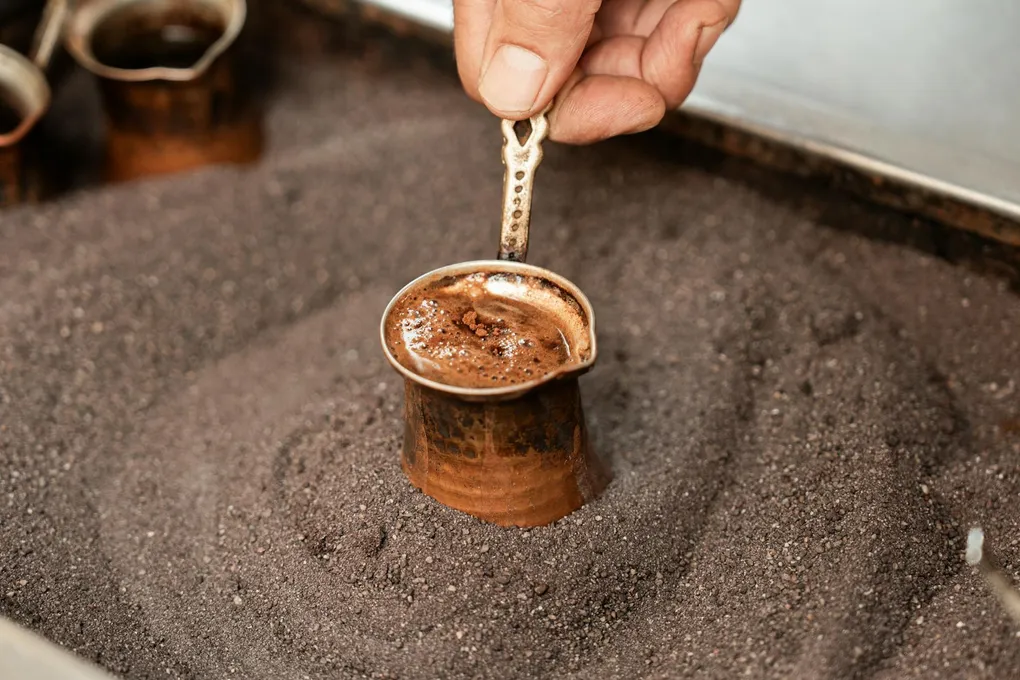
Turkish coffee is the oldest continuously practiced brewing method in the world. While pour over and espresso get the specialty spotlight, people in Istanbul, Athens, Beirut, and Cairo have been making coffee the same way for over five hundred years — grinding beans to powder, simmering them in a small copper pot, and pouring the whole thing, grounds and all, into a cup.
UNESCO agreed it was worth preserving. In 2013, they inscribed Turkish coffee culture as an Intangible Cultural Heritage of Humanity — not just the drink, but the entire ritual around it: the hospitality, the conversation, the fortune-telling from the grounds left in the cup.
The method itself is dead simple. But simple doesn’t mean careless. There are a handful of details that separate a beautiful cup of Turkish coffee from a bitter, scorched mess. Here’s how to get it right.
How It Works
Turkish coffee is a decoction — the grounds are boiled (or very nearly boiled) directly in the water and served unfiltered. There’s no paper, no metal mesh, no separation between the coffee and the liquid. You drink everything that dissolves and suspend everything that doesn’t. The finest particles settle to the bottom of the cup; you leave them there.
This is the opposite of what most modern brewing advice teaches. Every other method tries to separate the grounds from the liquid at the optimal moment. Turkish coffee doesn’t bother. The result is a cup with extraordinary body, intense flavor, and a thick, almost syrupy texture that nothing else replicates.
The grind is the finest of any brewing method — finer than espresso, approaching talcum powder. At roughly 75–200 micrometers, the particles are so small that they remain partially suspended in the liquid, contributing to that signature mouthfeel. Espresso grind typically peaks around 200–350 micrometers for comparison, while pour-over grinds sit higher at 400–700 micrometers. See our Grind Size Guide for the full spectrum.
What You Need
Cezve (ibrik): The small, long-handled pot is essential — you can’t substitute a saucepan. The narrow neck traps foam and controls the boil. Copper with tin lining is traditional and conducts heat best. Brass and stainless steel work fine. Size matters: a 2-cup cezve for 1–2 servings, 4-cup for 3–4. A serving is small — about 2–3 oz.
Grinder: This is the hard part. Most home grinders, even good ones, can’t grind fine enough for Turkish coffee. You need a dedicated Turkish grinder — either a traditional brass hand mill or a modern hand grinder with a Turkish setting (the 1Zpresso JX-Pro can get close). Pre-ground Turkish coffee from brands like Kurukahveci Mehmet Efendi is widely available and excellent.
Small cups: Traditional Turkish coffee cups (fincan) hold 2–3 oz. Espresso cups work.
Cold, filtered water. And optionally: sugar and cardamom.
Step by Step
The Recipe
Coffee: 7–10g per cup (roughly 1 heaping tablespoon) Water: 65–75ml per cup (about 2.5 oz) Ratio: Approximately 1:9 to 1:10 Grind: Powder-fine — the finest setting on any grinder, finer than espresso Sugar: Added before brewing (see below) Spice: 1 cracked cardamom pod or a pinch of ground cardamom (optional, common in Arab tradition)
1. Combine Everything Cold
Add cold water to the cezve first, then the coffee, then sugar if using. Stir briefly to wet the grounds. Some traditions say don’t stir at all — the coffee will incorporate as it heats. Either works.
Sugar must be decided now. You can’t add it after brewing — it would disturb the grounds. The traditional levels:
- Sade: No sugar
- Az sekerli: A little (half a teaspoon per cup)
- Orta: Medium (one teaspoon per cup)
- Sekerli: Sweet (one and a half to two teaspoons per cup)
If you’re new to Turkish coffee, start with orta. The sugar rounds the bitterness and complements the body.
2. Heat Slowly on Medium-Low
Place the cezve on the smallest burner at medium-low heat. Patience is everything here. You want the coffee to heat gradually over 2–3 minutes. High heat rushes the extraction and produces a harsh, one-dimensional cup.
Watch the surface. As the coffee heats, you’ll see a dark ring form around the edges. The surface will begin to glisten.
3. Watch for the Foam
As the temperature approaches boiling (~95–100°C), a thick, dark foam will begin to rise. This foam — called kaimaki in Greek, köpük in Turkish — is the hallmark of well-made Turkish coffee. It should be dense, creamy, and dark brown, like a thin layer of crema.
The critical moment: When the foam rises toward the rim of the cezve, remove it from heat immediately. Do not let it boil over. The traditional method calls for letting it rise three times, but modern competition brewers (the World Cezve/Ibrik Championship has been running since 2009) use a single rise. One controlled rise preserves more delicate flavors and produces a cleaner cup.
4. Pour Carefully
Spoon a small amount of foam into each cup first — this is a mark of good Turkish coffee. Then pour the liquid slowly, keeping the cezve close to the cup to preserve the foam. Don’t pour the last few drops; they’re mostly sludge.
5. Wait Before Drinking
Let the cup sit for 60–90 seconds. The grounds need time to settle to the bottom. Take a sip from the edge — the top of the cup should be clear and the bottom should be thick. You drink about two-thirds of the cup and leave the rest.
The Health Trade-Off
Turkish coffee is completely unfiltered, which means it passes the highest concentration of cafestol and kahweol of almost any brewing method. These diterpene lipids raise LDL cholesterol. Paper-filtered drip coffee contains about 12 mg/L of cafestol. Boiled/Turkish-style coffee can contain up to 939 mg/L of cafestol and 678 mg/L of kahweol — dramatically higher than even French press.
If you drink Turkish coffee occasionally, this is a non-issue. If it’s your daily method at 3+ cups, it’s worth discussing with your doctor if you have cholesterol concerns.
Caffeine content is moderate despite the intense flavor: 50–65 mg per 2 oz serving, since the serving size is small. A standard 8 oz drip coffee delivers 95–120 mg. Track your intake with our Caffeine Calculator.
The flip side: coffee’s overall health profile — reduced risks of type 2 diabetes, Parkinson’s, liver disease, and cardiovascular disease — applies regardless of brewing method. Turkish coffee is not “unhealthy.” It just passes more lipids than filtered methods.
What to Expect in the Cup
Well-made Turkish coffee is unlike anything else. The body is the heaviest of any brewing method — thick, almost velvety, with a texture that coats your mouth. The foam on top adds a creamy layer that contrasts with the dense liquid below.
Flavor tends toward dark chocolate, roasted nuts, and warm spice, especially if cardamom is added. Acidity is low — the near-boiling temperature and ultra-fine grind extract heavily, pushing past bright fruit notes into deep, rich, earthy territory.
Medium-to-dark roasts work best. Light roasts can taste flat and overly bitter in this method because the aggressive extraction pulls harsh compounds without enough sweetness to balance them. Traditional Turkish coffee uses a medium roast — darker than specialty light roast but lighter than Italian espresso roast.
The Ritual Beyond the Cup
Turkish coffee culture isn’t just about caffeine delivery. In Turkey, serving coffee to guests is a fundamental act of hospitality — the phrase “a cup of coffee commits one to forty years of friendship” is a common saying. During marriage proposals (kız isteme), the bride traditionally serves the prospective groom coffee — sometimes adding salt instead of sugar to test his composure.
Tasseography — fortune telling from the grounds — is practiced across Turkey, Greece, and the Arab world. After drinking, the cup is flipped onto the saucer, allowed to cool, and then “read” by interpreting the patterns the grounds leave on the inside of the cup. It’s not taken entirely seriously by most people, but it’s a social ritual that extends the coffee experience well beyond the last sip.
The Greek tradition (ellinikos kafes) is essentially identical in technique, differing mainly in the grind fineness and the tendency to serve without cardamom. In the Arab world, cardamom is nearly universal, and the coffee is often lighter in roast and served in smaller quantities as a gesture of welcome.
Troubleshooting
Bitter and harsh? Your heat was too high. Slow down — the total brew time should be at least 2–3 minutes. Also check your grind: if it’s not fine enough, extraction will be uneven (some powder, some coarser bits) and the coarser pieces contribute astringency.
No foam? The cezve may be too large for the amount of coffee, or the heat is too high. The foam forms best when the coffee heats slowly in a narrow-necked vessel. Also make sure the coffee is fresh — stale coffee produces less foam.
Too thick or sludgy? You poured too much. Leave the last quarter-inch in the cezve, and wait a full 60–90 seconds before your first sip.
Boiled over? It happens. Watch it more closely next time and reduce the heat. The foam rises fast once it starts — you need to be standing right there.
Why It Matters
In a world of precision pour overs and digitally controlled espresso machines, Turkish coffee is a useful reminder that great coffee doesn’t require technology. A copper pot, powdered coffee, water, and a flame. That’s it. The method hasn’t fundamentally changed since the Ottoman court perfected it in the sixteenth century.
What you get is a cup with more body than any other method, a ritual that turns coffee into conversation, and a direct line to the oldest coffee tradition on Earth. It’s not for every morning — the serving size is small, the cafestol is high, and the grounds in the cup take some getting used to. But it’s something every coffee person should experience at least once, and most people who try it properly come back for more.
Sources & Further Reading
- UNESCO: Turkish Coffee Culture and Tradition
- World Cezve/Ibrik Championship
- Gagné, J. The Physics of Filter Coffee (cafestol/diterpene data)
- Hoffmann, J. The World Atlas of Coffee (cultural context, brewing principles)
Some links above are affiliate links. If you purchase through them, we earn a small commission at no extra cost to you.
Frequently Asked Questions
- What grind size do I need for Turkish coffee?
- The finest grind of any brewing method — finer than espresso, close to the texture of flour or talcum powder. Most standard burr grinders can't achieve this. You'll need either a dedicated Turkish hand grinder, a high-end hand grinder with a Turkish setting, or pre-ground Turkish coffee. Kurukahveci Mehmet Efendi is the classic Istanbul brand and widely available online.
- Is Turkish coffee bad for your cholesterol?
- Turkish coffee is fully unfiltered, which means it contains the highest levels of cafestol and kahweol — diterpene lipids that raise LDL cholesterol — of any brewing method. At roughly 939 mg/L of cafestol compared to 12 mg/L in paper-filtered coffee, the difference is dramatic. Occasional cups are fine for most people, but if you drink it daily at high volumes and have cholesterol concerns, it's worth a conversation with your doctor.
- Should I let the foam rise once or three times?
- Traditional recipes call for three rises, but modern competition brewers (World Cezve/Ibrik Championship) have largely moved to a single, carefully controlled rise. One rise produces a cleaner, sweeter cup with better-preserved foam. Multiple rises tend to overextract the coffee and break down the foam structure.
- Can I add milk to Turkish coffee?
- Traditionally, no — Turkish coffee is served black with sugar. Adding milk isn't taboo, but it fights against the method's strengths. The ultra-fine suspended grounds, the thick body, and the foam are all part of the experience. If you want a milk-based coffee, a different brewing method will serve you better.
- How much caffeine is in Turkish coffee?
- About 50–65 mg per 2 oz serving. That's actually less total caffeine than an 8 oz cup of drip coffee (95–120 mg), because the serving size is so small. Per milliliter, Turkish coffee is among the most concentrated methods, but you're drinking far less of it per sitting.
- Do you eat the grounds at the bottom?
- No. You drink about two-thirds of the cup and stop when it gets thick and sludgy. The grounds at the bottom are left in the cup — and in Turkish tradition, they're used for fortune-telling (tasseography) by flipping the cup onto the saucer and reading the patterns.