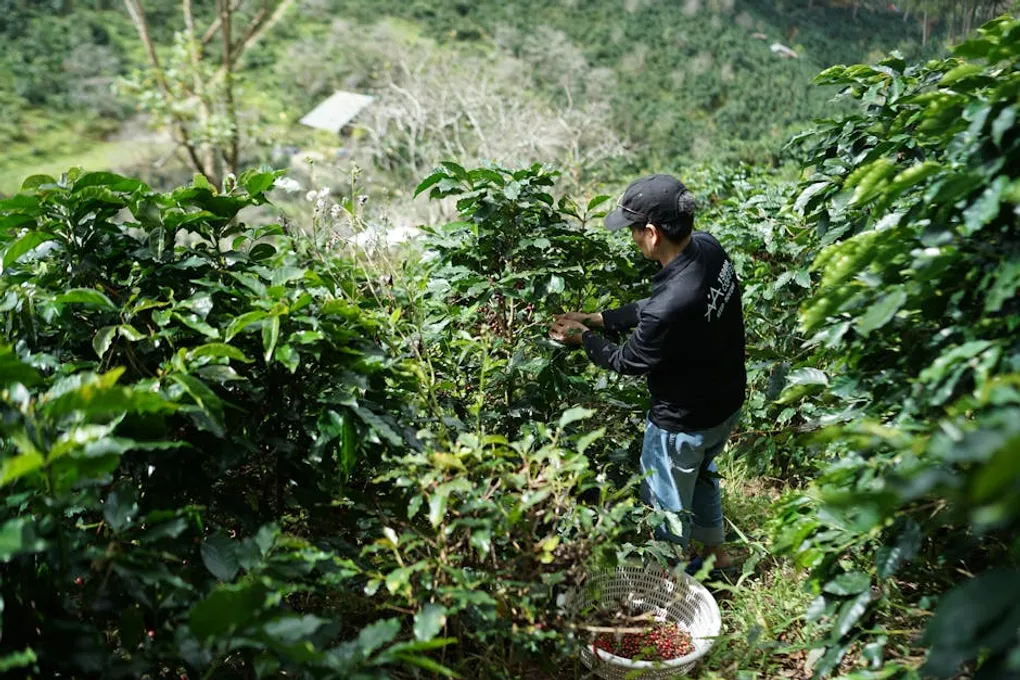
If you’ve tasted Bolivian coffee, you’re in a very small club. Bolivia produces roughly 20,000 to 30,000 bags of coffee annually — a number so small it barely registers as a rounding error in global statistics. Brazil produces that much before breakfast.
But what Bolivia lacks in volume, it compensates for in altitude, genetic purity, and sheer distinctiveness. The Yungas valley — a narrow strip of cloud forest descending from the Andes east of La Paz — grows coffee at altitudes that would be considered extreme almost anywhere else: 1,400 to 2,300 meters, with some farms pushing even higher. At those elevations, cherry maturation slows to a crawl, producing dense, concentrated beans with flavor complexity that punches far above the country’s commercial weight. If you’re new to single origin coffee, Bolivia is one of the most distinctive starting points you’ll find.
Bolivia hosted Cup of Excellence competitions from 2004 to 2009, and its winning lots surprised judges with SCA scores pushing into the 90s. More recently, the country launched its own Taza Presidencial competition — a producer-led quality event where the 2020 first-place coffee sold for $160 per pound — territory usually reserved for Panama, Ethiopia, and Kenya. The specialty world is slowly waking up. But with production this tiny, Bolivian coffee remains genuinely rare.
Where Coffee Grows in Bolivia
The Yungas
Nearly all of Bolivia’s coffee grows in the Yungas — a subtropical valley system on the eastern slopes of the Andes, dropping from the Altiplano plateau (4,000+ meters) into the Amazon basin. The Yungas is one of the world’s most biodiverse ecosystems: cloud forests, steep ravines, and a microclimate shaped by altitude, moisture rising from the Amazon, and dramatic temperature swings.
Caranavi is the epicenter of Bolivian coffee production. Located roughly 150 kilometers northeast of La Paz at 1,400 to 2,000 meters, Caranavi and the surrounding municipalities (Alto Beni, Coroico, Irupana) account for the vast majority of the country’s crop. The town itself serves as a collection and processing hub for hundreds of smallholder farmers in the surrounding hills.
Coroico, closer to La Paz and slightly higher, has a longer coffee history and produces some of Bolivia’s most celebrated lots. The road from La Paz to Coroico — the infamous “Death Road” (now mostly replaced by a modern highway) — descends 3,500 meters in 64 kilometers, passing through several distinct climate zones.
Alto Beni sits lower (800 to 1,400 meters) and produces larger volumes at lower quality. It’s more of the commodity base, while Caranavi and Coroico are where specialty lives.
Cochabamba is an emerging region worth watching. In 2021, Juan Calani Vargas from Cochabamba won the Taza Presidencial — Bolivia’s national quality competition — with a washed red Catuai scoring 91.45 points. The region’s potential is just beginning to be explored.
Growing Conditions
The Yungas offers near-ideal conditions for specialty coffee:
- Altitude: 1,400 to 2,300 meters — among the highest commercial coffee production anywhere. Learn more about how altitude shapes coffee flavor.
- Shade: Natural cloud forest canopy provides dappled shade without requiring managed shade trees
- Soil: Andean volcanic and alluvial soils, rich in organic matter from centuries of forest decomposition
- Climate: Cool nights (sometimes near freezing at highest elevations), warm days, consistent cloud cover
- Water: Abundant rainfall from Amazonian moisture systems, though drainage is good on the steep slopes
The result is slow, even cherry maturation — sometimes 9 to 10 months from flowering to harvest, compared to 6 to 7 months at lower altitudes. That extended development time concentrates sugars, acids, and aromatic precursors in the bean. Bolivia’s harvest season typically runs from May through September.
Varieties
Bolivia’s varietal landscape is relatively simple and remarkably pure:
- Typica: The dominant variety, and Bolivia’s greatest genetic asset. Much of Bolivia’s Typica stock is genuinely old — trees that have been growing for decades, relatively untouched by the waves of replanting that transformed other origins. At Yungas altitudes, Typica produces its finest expression: sweet, clean, complex, with delicate malic acidity.
- Caturra: Present in moderate quantities, particularly at mid-altitudes. Good productivity and quality.
- Catuai: Some plantings for its yield reliability.
- Catimor: Introduced after regional rust scares, but less prevalent than in neighboring Peru. Quality varies.
- Geisha and Pacamara: Appearing in newer plantings from quality-focused producers chasing higher competition scores and premium prices.
The relative absence of modern hybrids means Bolivia’s coffee has a genetic purity that’s increasingly rare in the commercial coffee world. Typica at 1,800+ meters in the Yungas is about as close to “heritage coffee” as you can get outside of Ethiopia or Yemen.
Processing
Washed: The primary method. Most Bolivian coffee is fully washed, with fermentation periods of 18 to 36 hours. The high altitude and cool ambient temperatures produce a clean, slow fermentation that enhances clarity. Well-processed Bolivian washed lots have a remarkable purity of flavor.
Natural: Growing slowly as producers experiment with quality differentiation. Natural-processed Bolivian coffee can show concentrated berry and tropical fruit notes — the high altitude and dense bean structure seem to handle the natural process well, with less defect risk than at lower elevations.
Honey: Uncommon but emerging. Some cooperatives have begun experimenting with honey processing, particularly for lots destined for specialty export.
What Bolivian Coffee Tastes Like
Bolivia’s flavor profile at its best is genuinely distinctive:
- Sweetness: Consistently high. Brown sugar, caramel, honey — the altitude-driven sugar concentration is evident.
- Acidity: Bright but gentle. Malic (apple, pear) more than citric. The best lots show a sparkling, juicy quality.
- Fruit: Stone fruit (peach, apricot), sometimes berry. More delicate than Ethiopian fruit, more present than Colombian.
- Chocolate: Milk chocolate undertones, sometimes cocoa nib.
- Body: Medium to medium-full. Silky texture.
- Finish: Clean, lingering sweetness. This is where Bolivia really stands out — the aftertaste holds.
The overall impression is of a refined, sweet, harmonious cup — not as wild as Yemeni or Ethiopian, not as straightforward as Peruvian, but occupying a unique space that’s both accessible and complex.
Why It’s Rare — and Expensive
Bolivia faces structural challenges that limit production:
- Coca competition: Like Yemen’s qat problem, Bolivia’s farmers can earn more growing coca (the base plant for cocaine) than coffee. The Chapare region adjacent to the Yungas is Bolivia’s primary coca-growing zone, and the economic pull is significant.
- Infrastructure: Roads in the Yungas are steep, narrow, and frequently damaged by landslides. Getting coffee from remote farms to processing facilities is logistically challenging.
- Scale: The average farm is 1 to 3 hectares. There are no large estates, no mechanized harvesting, no economies of scale.
- Market access: Bolivia lacks the export infrastructure and trade relationships that neighboring Colombia and Peru have built over decades.
- Frost risk: At the highest elevations, occasional frost events can damage or destroy crops.
These constraints mean that Bolivian specialty coffee typically retails for $22 to $40 per bag — more expensive than Peru but less than Kenya or Panama. Given the rarity and quality, it’s actually reasonable value. The challenge is finding it at all.
Where to Buy Bolivian Coffee
Bolivian coffee appears in specialty roaster catalogs seasonally — usually between July and November, when fresh-crop lots arrive. Look for:
- Named region (Caranavi, Coroico) and ideally farm or cooperative name
- Variety specified (Typica lots tend to be the best)
- Roast date within 2 to 3 weeks
- SCA score if available (look for 84+)
Several specialty importers — Cafe Imports, Royal Coffee, and Genuine Origin among them — carry Bolivian lots when available. The supply is inconsistent year to year, so when you see a good Bolivian coffee offering, buy it. It may not be there next month.
Brew Bolivian coffee as pour-over to capture the delicate acidity and sweetness, or try AeroPress for a more concentrated expression of the chocolate and fruit notes. A medium-fine grind works well for both methods.
Final Thoughts
Bolivia is the hidden gem that actually deserves the label. Not because it’s undiscovered — the Cup of Excellence program has been showcasing its quality since 2004 — but because the structural constraints that limit production also limit awareness. You can’t build a reputation when you barely produce enough to fill a single container ship.
If you find a fresh, well-roasted Bolivian Typica from Caranavi or Coroico, buy it without hesitation. It’s one of the most rewarding cups in specialty coffee — sweet, clean, complex, and carrying the fingerprint of some of the highest coffee farms on Earth. The beans may be rare, but the experience is unforgettable.
Some links above are affiliate links. If you purchase through them, we earn a small commission at no extra cost to you.
Frequently Asked Questions
- What does Bolivian coffee taste like?
- Bolivian coffee at its best is sweet, clean, and harmoniously complex. Expect brown sugar, caramel, stone fruit (peach, apricot), gentle malic acidity (apple, pear), milk chocolate, and a silky body with a lingering sweet finish. It's more refined than Peruvian coffee and more accessible than Ethiopian — occupying a unique space that's both gentle and interesting.
- Why is Bolivian coffee so rare?
- Bolivia produces only 20,000 to 30,000 bags annually — a tiny fraction of global output. Production is limited by coca competition (more profitable for farmers), challenging infrastructure (steep Yungas roads frequently damaged by landslides), small farm sizes (1 to 3 hectares), limited export infrastructure, and occasional frost risk at the highest elevations. These structural constraints keep volumes low regardless of demand.
- Where does Bolivian coffee grow?
- Nearly all Bolivian coffee grows in the Yungas — a narrow cloud forest valley on the eastern slopes of the Andes, descending from the Altiplano toward the Amazon basin. Caranavi (1,400 to 2,000m) is the main specialty area, with Coroico (1,500 to 2,300m) producing the highest-altitude lots. Bolivian coffee farms are among the highest on Earth.
- Is Bolivian coffee worth the price?
- At $22 to $40 per bag, Bolivian specialty coffee is more expensive than Peruvian or Honduran but significantly cheaper than Kenyan, Panamanian, or Yemeni. Given the rarity, altitude-driven complexity, and the fact that Bolivia's Typica at 1,800+ meters is genuinely distinctive, it represents solid value. The challenge is finding it — supply is seasonal and inconsistent.
- How should I brew Bolivian coffee?
- Pour-over (V60 or Chemex) best showcases Bolivia's delicate acidity and clean sweetness. Use water at 200 degrees F, medium-fine grind, and a 1:16 ratio. AeroPress also works well for a more concentrated expression. The dense, high-altitude beans may benefit from slightly hotter water or finer grind than you'd use for lower-altitude origins. Medium roast preserves the origin's best qualities.