The Science of Dialing In: Why Every Bean Needs Its Own Recipe
Coffee brewing is the controlled dissolution of soluble compounds from ground beans into water. Roasted coffee is roughly 28 to 30 percent soluble by weight; the rest is insoluble cellulose. Pull out too little and the cup tastes sour and thin — the sugars and acids leave the bean before the body does. Pull out too much and the cup turns bitter and dry as the later-extracting compounds flood in. The target window is narrow: 18 to 22 percent extraction yield with total dissolved solids between 1.15 and 1.45 percent for filter coffee. Everything else — grind size, water temperature, contact time, ratio — is in service of hitting that window.
A single universal recipe cannot reach that window across 329 different coffees. Beans differ in density, moisture content, processing method, roast level, and age, and each variable shifts how water attacks the grounds. High-altitude washed Ethiopian coffees are dense, acidic, and extract slowly — they usually want finer grinds and longer contact time. Naturals from the same country are less dense, carry more residual sugars, and extract more readily — they often want slightly coarser grinds to avoid turning syrupy. Pulped-natural and honey-process coffees sit between the two. Dark roasts, regardless of origin, are more porous and brittle; they give up solubles quickly and overextract easily. The same gram of coffee yields a different cup depending on every one of these axes.
Why the brewer matters as much as the bean
Brewers change the geometry of extraction. A Hario V60 uses a 60-degree conical cone with a single large exit hole and thin paper filter, which produces fast, uneven percolation and demands a grind fine enough to slow the flow without clogging it. A Chemex uses a thicker bonded filter that traps fines and oils, yielding a cleaner cup but requiring a coarser grind and longer pour rhythm to compensate for the drag. An AeroPress is a pressurized immersion-percolation hybrid where contact time is almost entirely in your hands. Espresso compresses all of this into a 25 to 35 second window at nine bars of pressure, which changes the math completely — there the dial is on the order of a few microns of grind adjustment. Feed the same bean through each of these and the correct grind, ratio, and time shifts meaningfully.
Grind fines are the hidden dial
Jonathan Gagné's analysis of 300 particle-size distributions across 24 grinders found that burr type shapes the distribution in ways that go beyond the median particle size. Flat burrs tend toward unimodal distributions — a single peak with fewer outliers. Conical burrs produce bimodal distributions with a main peak plus a secondary peak of fines. When we dial in, Gagné argues, "we are dialing in the amount of fines more so than we are dialing in the average size of coarse particles." Fines punch above their weight: a particle one-tenth the median diameter has one-thousandth the volume but vastly more surface area per unit mass. They extract fast, clog paper filters, and set the hydraulic resistance of the puck. This is why two grinders set to the same "V60 setting" can produce noticeably different cups. The recipes in this tool assume a reasonably consistent grinder; small clicks in either direction should get you the rest of the way there.
Water, temperature, and the evenness problem
Water chemistry is the most-ignored variable. The SCA target is roughly 150 ppm total dissolved solids with balanced calcium-magnesium hardness and enough bicarbonate alkalinity to buffer acidity without muting it. Very soft water (under 75 ppm) makes coffee taste flat and sour; very hard water over-extracts and leaves scale in the machine. Temperature matters in a linear-ish way — higher temperatures accelerate extraction, but only if the beans can tolerate it. Light roasts usually prefer 96 to 99°C water; medium roasts are comfortable at 92 to 96°C; dark roasts often taste better at 88 to 92°C because the lower heat holds back the harsh bitter notes the darker roast has already developed. What ties everything together is evenness of extraction: the difference between a good and a great cup often comes down to whether every particle in the bed extracted at the same rate, not whether the average extraction was on target.
Why 2,961 recipes beats one
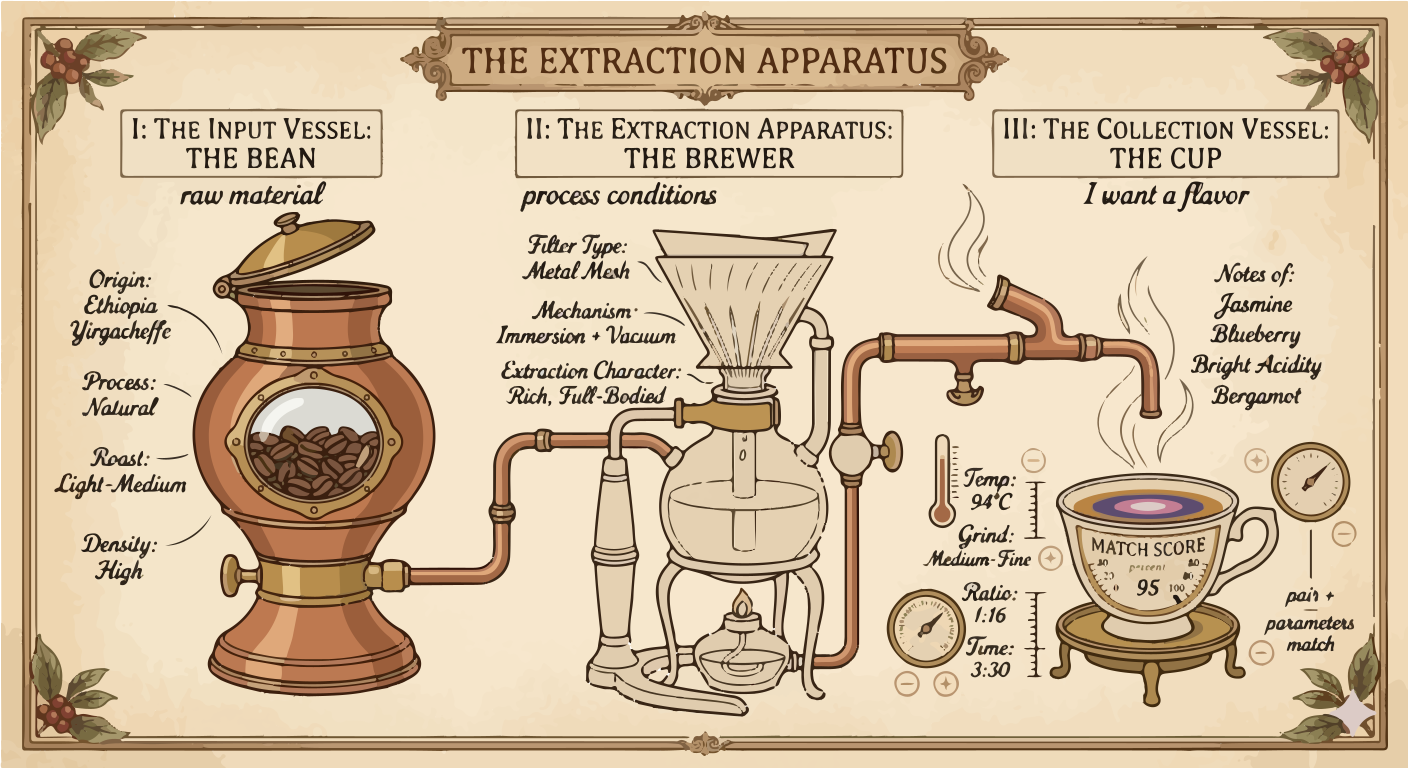
Multiply 329 beans by nine brewers and you get 2,961 possible combinations. Most brewing guides collapse that down to a single recipe per method — "pour-over: 1:16 ratio, 94°C, 3:30 total" — which is a fine starting point and a poor ending point. The point of dialing in is that the starting recipe is an educated guess and the final recipe comes from tasting. What this tool does is narrow the educated guess from "any coffee, any brewer" to "this specific bean through this specific brewer" so the first cup is closer to the window than a generic recipe can be. From there, the classic adjustment rules apply: if it tastes sour or thin, grind finer or raise temperature; if it tastes bitter or harsh, grind coarser or lower temperature; if body feels thin, increase dose. Change one variable at a time. The recipe is the starting point, your palate is the endpoint.