Peru doesn’t get enough credit. The country is the world’s largest exporter of organic coffee, the seventh-largest coffee producer overall, and it grows some of the sweetest, cleanest specialty beans in South America — often at prices that make Colombia and Guatemala look overpriced.
The problem is visibility. Peruvian coffee has historically been sold through cooperatives that blend lots from hundreds of small farms, creating uniform but anonymous green coffee that disappears into commercial blends. The origin rarely makes it onto the bag. You’ve almost certainly drunk Peruvian coffee. You just didn’t know it.
That’s changing. Peru’s Cup of Excellence program (launched in 2017) has spotlighted individual farms producing competition-grade lots. Specialty importers are building direct relationships with cooperatives in Chanchamayo, Cajamarca, and Cusco. And the sheer volume of certified organic production — roughly 30% of Peru’s entire crop — appeals to a growing segment of buyers who care about sustainability alongside flavor.
If you’re looking for exceptional daily-drinking coffee that won’t break the bank, Peru should be near the top of your list.
Coffee History in Peru
Coffee arrived in Peru in the mid-1700s, introduced by Spanish colonists in the northern highlands. For two centuries, it remained a minor crop — Peru’s economy revolved around mining, agriculture (principally potatoes and corn), and coca.
Commercial coffee production expanded significantly in the late 1800s and early 1900s, particularly in the central jungle regions east of the Andes. European immigrants — particularly Germans and Italians — established the first large coffee estates in Chanchamayo and the Junín region, bringing agricultural expertise and export connections.
For most of the 20th century, Peruvian coffee was commodity-grade. The country lacked the processing infrastructure, quality culture, and trade relationships that Colombia and Central American producers had built. The Shining Path insurgency (1980s—1990s) devastated rural areas, displacing farmers and destroying infrastructure that would take decades to rebuild.
The transformation began in the early 2000s when international development organizations — USAID, TechnoServe, Rainforest Alliance, and others — invested heavily in Peruvian coffee quality. Cooperative-based production models spread across the highlands. Organic and Fair Trade certification became widespread, giving Peruvian farmers a premium path that didn’t require competing head-to-head with Colombia’s established specialty infrastructure.
Today, Peru produces roughly 4.2 million bags annually from an estimated 223,000 farming families, making it a story of volume driven by sheer numbers of small producers rather than large estates.
Growing Regions
Peru’s coffee grows on the eastern slopes of the Andes, where the mountains descend into the Amazon basin. This transition zone — called the ceja de selva (eyebrow of the jungle) — provides altitude, moisture, and biodiversity that coffee loves. The country’s vast north-south extent means growing conditions vary significantly by region.
Chanchamayo (Junín)
Peru’s most famous coffee region and historically the heart of the country’s industry. Located in the central Junín department at 1,200—1,800 meters, Chanchamayo benefits from fertile soils, consistent rainfall, and a well-established cooperative infrastructure.
Chanchamayo coffee is the Peruvian archetype: sweet, clean, mild acidity, with chocolate and nutty notes. The region’s cooperative model (cooperatives like CAC Pangoa and Perales Huancaruna) means most coffee is carefully sorted and processed — the consistency is high even if the individual farm traceability is limited.
Flavor profile: Sweet, mild, chocolate, nut, clean finish, balanced acidity.
Cajamarca
Northern Peru’s Cajamarca region has emerged as the country’s quality leader over the past decade. Farms here sit at 1,400—2,000 meters — higher than Chanchamayo — and the cooler temperatures produce denser, more complex beans. Cajamarca’s Jaén and San Ignacio provinces have become particularly celebrated, producing lots that score 85—89 SCA points.
The region’s isolation (poor roads, limited infrastructure) has been both a curse and a blessing — logistics are difficult, but the remoteness has preserved traditional farming practices and diverse shade-grown ecosystems.
Flavor profile: Bright acidity, citrus, stone fruit, floral notes, more complex than Chanchamayo.
San Martín
The San Martín department in northeastern Peru is the country’s largest coffee-producing region by volume, though quality varies widely. Farms range from 800 to 1,600 meters. The lower-altitude lots tend toward commercial grade, but higher-elevation farms around Lamas and Moyobamba are producing increasingly impressive specialty coffee.
San Martín is also significant for Peru’s organic story — the region has one of the highest concentrations of certified organic farms in the country.
Flavor profile: Variable. Best lots: sweet, nutty, caramel, mild acidity. Lower-altitude: flat, woody.
Cusco (Quillabamba)
The ancient Incan capital region produces coffee in the Quillabamba Valley at 1,200—1,800 meters. Growing conditions are excellent — volcanic soil, abundant moisture, and altitude. But Cusco’s remoteness (roads are rough, and the nearest port is far) limits export infrastructure.
Cusco’s best lots offer a distinctive profile: heavier body than other Peruvian regions, dark chocolate, brown sugar, and a sweetness that’s almost syrupy. Small cooperatives like COCLA have built quality programs that are starting to attract specialty attention.
Flavor profile: Heavy body, dark chocolate, brown sugar, syrupy sweetness, low acidity.
Varieties
Peru’s varietal landscape is dominated by traditional cultivars:
- Typica: The historic backbone. Peru grows more Typica than almost any other country, and at altitude the variety delivers its best expression — sweet, clean, malic acidity, delicate.
- Caturra: Widely planted for its productivity. Good cup quality when grown above 1,400 meters.
- Bourbon: Present in smaller quantities, particularly in Cajamarca. Sweet, complex, low-yielding.
- Catimor: Planted extensively after the 2013 leaf rust epidemic for its disease resistance. Cup quality is inconsistent — good at altitude, mediocre below 1,200 meters.
- Pache: A Typica mutation grown at medium altitudes. Moderate quality.
The 2013 rust crisis hit Peru hard, particularly in Cajamarca and Junín. Many farmers replanted with Catimor, which has somewhat diluted the overall quality profile. The specialty sector’s challenge now is encouraging farmers to maintain Typica and Bourbon at altitude while finding economically viable rust-resistant alternatives (like Marsellesa or F1 hybrids) for lower-altitude plots. For a deeper dive on how these varieties differ, see our guide to coffee varieties explained.
Processing
Washed: The dominant method (roughly 80% of production). Peruvian washed coffees are characteristically clean and sweet — the processing emphasizes the bean’s natural sweetness without adding fruit-forward complexity. See our full guide to coffee processing methods for how washed processing shapes the cup.
Natural: Uncommon but growing, particularly among quality-focused cooperatives in Cajamarca. Natural-processed Peruvian coffee can show dried fruit, berry, and wine-like notes that add dimensionality to the typically mild profile.
Honey: Very limited but emerging. Some Cajamarca farms have begun experimenting with honey processing, influenced by Costa Rican and Salvadoran techniques.
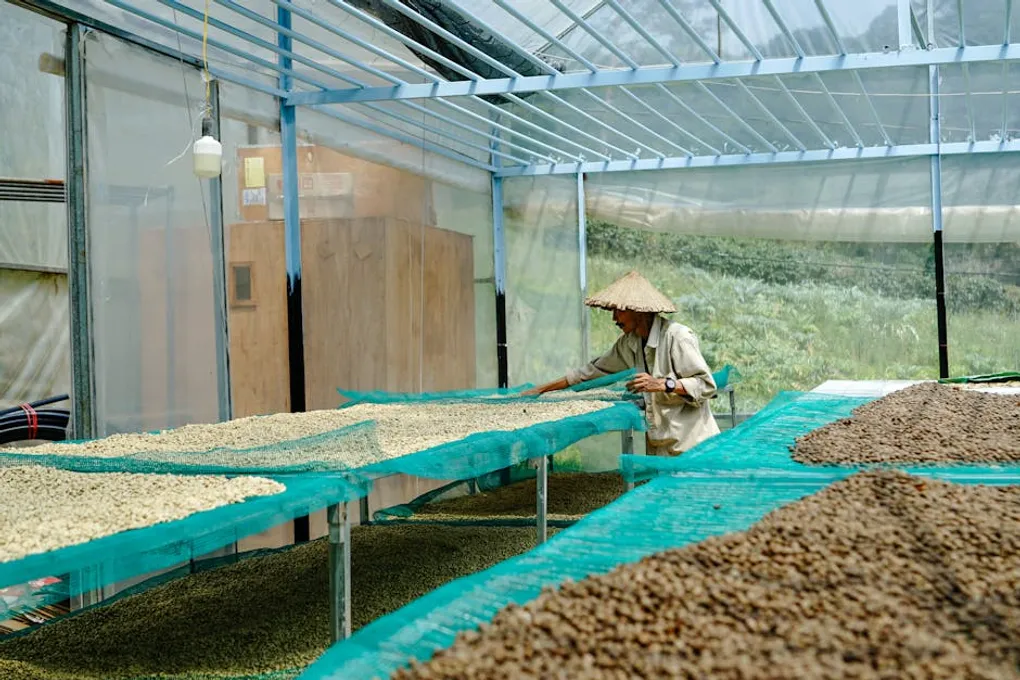
One challenge for Peruvian processing is drying infrastructure. Many farms in remote areas lack mechanical dryers or even properly constructed drying patios, relying on tarps on the ground — which can introduce defects. Investment in drying infrastructure is one of the highest-leverage improvements available to Peruvian quality.
The Organic and Fair Trade Story
Peru’s dominance in organic coffee isn’t accidental. The country’s smallholder-dominated production model means that many farms are de facto organic — they simply can’t afford chemical inputs. Formalizing that into certification provides a price premium ($0.30—0.50/lb above commodity) that’s meaningful for farmers earning $2—4 per day.
Roughly 30% of Peru’s coffee carries organic certification, and the country also leads in Fair Trade and Rainforest Alliance certifications. For buyers who prioritize sustainability and ethical sourcing, Peru offers a combination of certification depth and competitive pricing that’s hard to match.
There’s a legitimate debate about whether certification premiums actually reach farmers (cooperatives take processing and marketing cuts), and whether the premiums are sufficient to incentivize quality over volume. But the framework exists, and it’s more developed in Peru than in most origins.
What Peruvian Coffee Tastes Like
Across regions and varieties, Peruvian coffee has a recognizable character:
- Clean sweetness: The signature trait. Peruvian coffee is sweet without being flashy — think brown sugar, honey, caramel.
- Mild acidity: Pleasant but rarely intense. More apple than lemon. Cajamarca lots push toward citrus brightness, but even then it’s gentle.
- Chocolate and nut: The most common tasting notes. Milk chocolate, cocoa, roasted almond, walnut.
- Medium body: Not heavy, not thin. Balanced mouthfeel that works across brew methods.
- Clean finish: Well-processed Peruvian coffee has a remarkably clean, fade-to-sweet finish.
The trade-off: Peruvian coffee rarely produces the explosive, distinctive cups you get from Kenya, Ethiopia, or Panama. It’s not trying to. Peru’s strength is reliability, balance, and sweetness — the kind of coffee you want to drink every morning without ever getting tired of it.
Understanding how altitude shapes flavor helps explain why Cajamarca’s higher farms outperform Chanchamayo’s lower ones in complexity and acidity.
Best Peruvian Coffees to Buy
- Entry point ($12—16): Cooperative-blended organic from Chanchamayo or San Martín. Consistent, sweet, clean.
- Mid-range ($16—24): Single-region Cajamarca or Cusco from named cooperatives. This is where Peru’s quality ambitions show up.
- Splurge ($24—35): Cup of Excellence or micro-lot Typica/Bourbon from Cajamarca. Competition-grade quality at prices that would be laughable from Colombia or Kenya.
Peru is one of the most versatile brewing origins. Its balanced profile works beautifully as drip, pour-over, French press, or AeroPress. For espresso, Peruvian beans make excellent single-origin shots (sweet, chocolatey, forgiving) and blend components.
For brew water temperature and ratio guidance, see what’s the ideal coffee brewing temperature. For grind settings by method, see the coffee grind size guide.
You can find Peruvian organic coffee on Amazon — look for bags that name the region (Chanchamayo, Cajamarca) and list a roast date.
Final Thoughts
Peru is the origin you should be drinking when you’re not thinking about origins. It’s the Tuesday morning coffee, the afternoon pick-me-up, the beans you grind on autopilot and still enjoy. Not because it’s unremarkable — but because its particular brand of excellence is quiet, consistent, and deeply satisfying.
Cajamarca’s best lots prove that Peru can play the specialty game when it wants to. But the country’s real contribution to coffee might be something more important: showing that organic, cooperative-grown, ethically sourced coffee doesn’t have to cost $30 a bag to be genuinely good. In a market that increasingly equates price with quality, Peru is a welcome reminder that great coffee can also be affordable coffee. Peru’s agricultural diversity extends beyond coffee — the country is also one of the most flavor-diverse cacao origins on earth, with native Criollo genetics producing some of the rarest chocolate in the world.
Some links above are affiliate links. If you purchase through them, we earn a small commission at no extra cost to you.
Frequently Asked Questions
- Why is Peruvian coffee so affordable?
- Peru's coffee is priced lower than comparable origins because of structural factors, not quality. The cooperative-dominated production model blends lots from many small farms, which limits individual farm branding. Poor infrastructure in remote regions adds cost while reducing visibility. And the country's reputation as a commodity producer still lingers, even as specialty quality has improved dramatically. The result is genuine specialty quality -- particularly from Cajamarca -- at prices that undercut Colombia or Guatemala by 20-40%.
- Is Peru really the world's largest organic coffee producer?
- Yes. Roughly 30% of Peru's entire coffee crop carries organic certification, making it the world's leading organic coffee exporter. Many Peruvian farms are de facto organic because smallholders simply can't afford chemical inputs. Formalized certification provides a meaningful price premium ($0.30-0.50/lb) that helps sustain farming families earning $2-4 per day.
- What does Peruvian coffee taste like?
- Peruvian coffee is characteristically sweet, clean, and balanced. Expect chocolate, nut, caramel, and brown sugar with mild, pleasant acidity and medium body. It's the kind of coffee that works beautifully every day without fatiguing your palate. Cajamarca lots push into more complex territory -- citrus, stone fruit, floral notes -- while Cusco offers heavier body and darker chocolate.
- What is Chanchamayo coffee?
- Chanchamayo is Peru's most famous coffee region, located in the central Junín department at 1,200-1,800 meters on the eastern Andes slopes. It's the historical heart of Peruvian coffee, with well-established cooperatives and consistent processing. Chanchamayo coffee is the Peruvian archetype: sweet, mild, chocolatey, clean.
- How should I brew Peruvian coffee?
- Peru's balanced profile makes it one of the most versatile brewing origins. Drip, pour-over, French press, and AeroPress all work beautifully. For espresso, Peruvian beans produce sweet, chocolatey, forgiving shots that are excellent as single origins or blend components. Medium roast brings out the sweetness and chocolate; light roast reveals more citrus and fruit in higher-altitude Cajamarca lots.