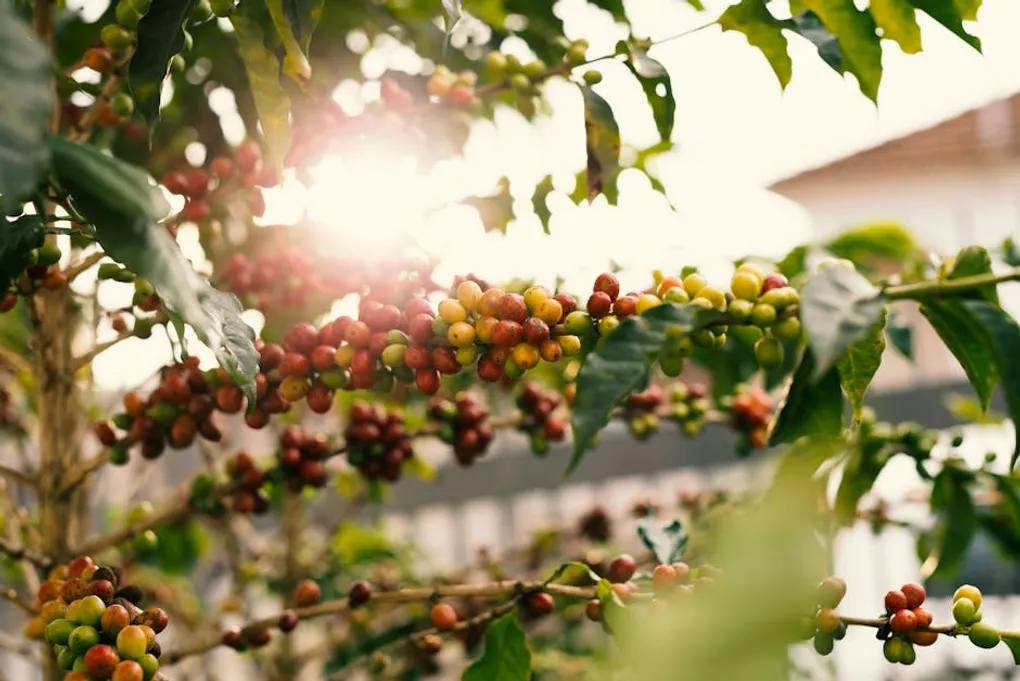
Every bag of specialty coffee lists a variety name. Bourbon. Typica. Geisha. SL28. Caturra. Pacamara. These names show up right alongside origin and processing method, presented as if every coffee drinker should know what they mean. Most don’t — and honestly, the coffee industry hasn’t done a great job explaining why they should care.
Here’s why they should: variety is one of the three factors (alongside terroir and processing) that determines what your coffee tastes like. Just as a Pinot Noir grape produces a fundamentally different wine than a Cabernet Sauvignon grown in the same vineyard, a Bourbon coffee plant produces a different cup than a Typica or a Geisha planted in the same soil at the same altitude. The variety sets the genetic ceiling. Everything else — farming, processing, roasting — works within those bounds.
The coffee family tree is surprisingly small. All commercial coffee comes from just two species, and all the specialty coffee you’ve ever tasted almost certainly comes from one: Coffea arabica. Within that single species, a handful of key varieties branch into everything you see on bags today.
The Two Species: Arabica and Robusta
All commercial coffee comes from two species in the Rubiaceae family:
Coffea arabica accounts for about 60% of global production and virtually 100% of specialty coffee. It’s self-pollinating, genetically narrow (very low diversity compared to most crop species), and produces the complex, nuanced flavors that specialty coffee is built on. It’s also fragile — susceptible to disease, pests, and climate stress.
Coffea canephora (Robusta) accounts for the other 40%. It’s hardier, higher-yielding, more disease-resistant, and higher in caffeine (nearly double Arabica). Its genetic diversity is much larger than Arabica and is only beginning to be explored. The cup quality reputation is harsh — earthy, rubbery, bitter — but “Fine Robusta” is an emerging category, with Brazilian variety BRS 2314 scoring 87.2 SCA points in evaluation, featuring chocolate, caramel, and fruit notes that challenge old assumptions.
For now, though, the specialty world is an Arabica story. And within Arabica, two foundational varieties define the family tree.
The Two Founders: Bourbon and Typica
Nearly every Arabica variety you’ll encounter traces back to one of two lineages:
Typica is the original cultivated coffee, descended from the handful of plants that left Ethiopia centuries ago and eventually reached Java (via Yemen and India) and the Americas (via a single plant gifted to Louis XIV’s botanical garden in Paris, then shipped to Martinique around 1720). Typica is tall, low-yielding, disease-susceptible, and produces cups of very good quality — clean, sweet, complex. It’s being slowly replaced worldwide because farmers can’t afford its low yields, but where it survives, the cup quality is excellent.
Bourbon diverged from Typica on the island of Réunion (then called Bourbon) in the Indian Ocean. French missionaries brought coffee from Yemen to Réunion in the early 1700s, and centuries of isolation produced a genetically distinct population. Bourbon is slightly more productive than Typica with arguably equal or better cup quality — it’s one of the most important cultivars in specialty coffee globally. Sweet, balanced, complex, with a richness that many cuppers consider the benchmark for what good Arabica should taste like.
From these two parents, the entire tree branches outward.
The Bourbon Branch
Bourbon has been remarkably prolific as a parent. Natural mutations and deliberate selections have produced some of specialty coffee’s most important varieties:
Caturra — A natural dwarf mutation of Bourbon, discovered in Brazil around 1937. Compact plants that yield significantly more per hectare than Bourbon. Cup quality is very good — bright and clean. Caturra became the standard reference for yield in the industry and is planted widely across Latin America. Susceptible to rust and all other major diseases.
SL28 — A selection made by Scott Agricultural Laboratories in Kenya in the 1930s from Bourbon-related stock. SL28 is considered one of the highest cup quality varieties in existence — the standard reference for quality in Africa. Intense berry fruit, wine-like acidity, complex sweetness. Low-yielding, tall, disease-susceptible, but when you taste a great Kenyan AA, it’s almost certainly SL28. Worth every bean the farmer sacrificed in yield.
Pacas — A natural Bourbon mutation discovered in El Salvador in 1949. Dwarf stature, moderate yield, very good cup quality. Important as a parent of Pacamara.
Villa Sarchi — Another natural Bourbon mutation, this one from Costa Rica. Dwarf, moderate yield, very good quality. Important as a parent of the Sarchimor group of rust-resistant varieties.
Tekisic — An improved Bourbon selection from El Salvador, sometimes called “Bourbon Tekisic.” Refined through selection for better productivity while maintaining Bourbon’s cup quality.
K7 — A Bourbon selection from Kenya with some tolerance to coffee leaf rust and coffee berry disease. Moderate yield, good quality. One of the few heritage varieties with any disease resistance.
The Typica Branch
Typica’s descendants are fewer but include some memorable varieties:
Maragogipe — A Typica mutation discovered in Brazil’s Maragogipe region. Produces dramatically oversized beans — the largest in commercial coffee. Low yield, tall plants, good but not exceptional cup quality. The giant beans have a novelty factor that commands attention and moderate premiums.
SL34 — Another Scott Labs Kenya selection, this one from the Typica lineage. Very good cup quality, slightly more productive than SL28. Large beans. Often planted alongside SL28 on Kenyan farms.
Kona — Hawaiian Typica, descended from trees brought from Guatemala in the 1800s. Grown exclusively in the Kona district on Hawaii’s Big Island. The terroir — volcanic soil, cloud cover, tropical warmth — gives Kona Typica its distinctive mild, sweet, clean character. The variety itself is standard Typica; it’s the place that makes it special.
Bourbon x Typica Crosses
Some of the most interesting varieties come from crossing the two founder lineages:
Mundo Novo — A natural Typica x Bourbon cross discovered in Brazil. Accounts for roughly 40% of Brazilian coffee production. Tall, high-yielding, good quality. The workhorse of Brazilian coffee.
Catuai — Mundo Novo x Caturra. Dwarf, very high-yielding, good quality. Planted massively across Latin America. Susceptible to everything disease-wise, but the productivity is hard to argue with.
Pacamara — Pacas (Bourbon mutation) x Maragogipe (Typica mutation), created in El Salvador in 1958. Tall plants, very large beans, medium yield, very good cup quality. Pacamara is not genetically stable — plants from seed don’t breed true — which makes it unusual in the catalog. But the cup, at its best, delivers a distinctive stone fruit, citrus, and floral complexity that’s earned it a dedicated following.
The Ethiopian Wild Cards
Ethiopia — where coffee originated — contains genetic diversity that dwarfs the entire Bourbon-Typica family tree. Most Ethiopian coffee comes from heirloom varieties that have never been formally classified. The coffee industry labels them “Ethiopian Heirloom” as a catch-all, which is like labeling a thousand different apple cultivars simply “fruit.”
Geisha (Gesha) — Originally collected from the forests near the town of Gesha in southwestern Ethiopia, Geisha was brought to Costa Rica in the 1950s as a rust-resistance research candidate. It languished in obscurity until 2004, when the Peterson family of Hacienda La Esmeralda in Panama entered it in the Best of Panama competition and it scored so far above everything else that it essentially created a new price tier for specialty coffee.
Geisha’s cup profile — intense jasmine florals, bergamot, tropical fruit, tea-like body — is unlike any other variety. The World Coffee Research catalog rates it “Exceptional” for cup quality. It’s also low-yielding, tall, and disease-susceptible. A Geisha lot from La Esmeralda sold for $6,034/lb at the 2024 Best of Panama auction. The variety has since been planted in Colombia, Ethiopia, Guatemala, and other origins, but Panama Geisha remains the reference point.
The Rust-Resistant Varieties: Catimors and Sarchimors
Coffee leaf rust (Hemileia vastatrix) is one of the greatest threats to coffee production. In the early 1900s, a natural cross between Arabica and Robusta was discovered on the island of Timor — the Timor Hybrid. It carried Robusta’s rust resistance in an Arabica-compatible package.
Breeders crossed the Timor Hybrid with existing Arabica varieties to create rust-resistant offspring:
Catimor group (Timor Hybrid x Caturra) — Includes varieties like Catimor 129, Costa Rica 95, Lempira, and IHCAFE 90. High-yielding, compact, rust-resistant. Cup quality has historically been mediocre — the Robusta genetics can contribute earthy, flat flavors, especially at lower altitudes. At altitude (1,400m+), well-processed Catimor can produce clean, acceptable coffee. An important clarification from the World Coffee Research catalog: “Catimor” is not a single variety but a group of many distinct varieties with similar parentage.
Sarchimor group (Timor Hybrid x Villa Sarchi) — Includes Marsellesa, Parainema, IAPAR 59, and Obata Red. Generally better cup quality than the Catimor group while maintaining rust resistance. Marsellesa in particular is recommended as a replacement for susceptible varieties — very high yield, highly resistant, good quality.
The alarming development: Rust resistance is breaking down. Lempira in Honduras and Costa Rica 95 in Costa Rica — both bred specifically for rust resistance — have been infected in recent years. Because most resistant varieties share the same Timor Hybrid parent, most experts believe existing rust resistance will fail in the near-to-medium term. The disease evolves; the varieties don’t.
F1 Hybrids: The Future
F1 hybrids represent the cutting edge of coffee breeding. Created by crossing two genetically distinct Arabica parents, they combine high cup quality, high yield, and disease resistance — the trifecta that traditional varieties force farmers to choose between.
Centroamericano (H1) — The star of the category. A cross between Sarchimor T5296 and Rume Sudan (a wild Ethiopian accession). The WCR catalog rates it Exceptional for cup quality, Very High for yield, and Highly Resistant for rust. It’s essentially the variety that proves you don’t have to sacrifice quality for resistance.
Starmaya — Unique among F1 hybrids because it can be reproduced by seed (using a male-sterile line), rather than requiring expensive tissue culture propagation. Marsellesa x Rume Sudan. Very high yield, very good quality, highly resistant.
The catch: most F1 hybrids must be clonally propagated — tissue culture or cuttings — because seeds won’t breed true. The child plant won’t perform like the parent. This means farmers must buy seedlings from trusted nurseries rather than saving seed, which adds cost and supply-chain complexity.
Why Variety Matters in Your Cup
A rough flavor guide by variety group:
- Typica/Bourbon (heritage): Sweet, balanced, clean, complex. The classic specialty profile. What most people think of as “good coffee.”
- SL28/SL34 (Kenyan selections): Intense fruit, wine-like acidity, bold. The high-wire act of specialty coffee.
- Geisha: Floral, jasmine, bergamot, tea-like. Unmistakable and unlike anything else.
- Pacamara: Stone fruit, citrus, floral, full body. Big beans, big flavor.
- Caturra/Catuai: Bright, clean, good acidity. Reliable rather than spectacular.
- Catimor/Sarchimor (rust-resistant): Clean, mild, moderate complexity at altitude. Improving rapidly.
- Ethiopian Heirloom: Wildly variable — floral, fruity, berry, wine, chocolate. The broadest flavor range of any origin, because the genetic diversity is unmatched.
For context on how variety interacts with origin, see our guide to what is single origin coffee. And for how altitude shapes flavor — which affects how variety expresses itself — that guide explains why a Typica at 2,000m tastes different from the same variety at 1,200m.
The next time you pick up a bag of specialty coffee, look at the variety name alongside the origin and process. Those three pieces of information, together, tell you more about what’s in the cup than anything else on the label.
Some links above are affiliate links. If you purchase through them, we earn a small commission at no extra cost to you.
Frequently Asked Questions
- Why does coffee variety matter for flavor?
- Variety sets the genetic ceiling for what a coffee can taste like, the same way grape variety determines wine character. An SL28 planted next to a Catimor at the same altitude, processed the same way, will produce a fundamentally different cup -- the SL28 will have more fruit complexity and intensity. Terroir and processing work within the bounds that genetics establishes.
- What's the difference between Bourbon and Typica?
- Both are founding Arabica varieties, and both produce excellent cup quality. Bourbon tends toward rich sweetness and balance; Typica tends toward clean, nuanced complexity. Bourbon is slightly more productive. In practice, the differences are subtle -- both are considered benchmark quality varieties, and both are being slowly replaced by higher-yielding cultivars because farmers can't afford the low yields.
- Why is Geisha coffee so expensive?
- Geisha plants yield very little fruit, are tall and difficult to farm, and are susceptible to disease. The cup quality, however, is exceptional -- intense jasmine florals, bergamot, tropical fruit -- unlike any other variety. The combination of scarcity and unmistakable quality drives auction prices: a Geisha lot from Panama's Hacienda La Esmeralda sold for $6,034/lb in 2024. You're paying for rarity and a genuinely unique flavor experience.
- What does "Ethiopian Heirloom" mean on a bag?
- It's a catch-all label for the thousands of unclassified coffee varieties growing in Ethiopia, where coffee originated. The genetic diversity in Ethiopian forests dwarfs the entire Bourbon-Typica family tree, but most varieties have never been formally catalogued. When a bag says "Ethiopian Heirloom," it means the specific variety is unknown -- which is frustrating for traceability but reflects the genuine wild diversity of coffee's homeland.
- Should I avoid Catimor and other rust-resistant varieties?
- Not necessarily. The old reputation for mediocre cup quality was earned at low altitudes with poor processing. At altitude (1,400m+), well-processed Catimor and Sarchimor varieties produce clean, sweet, respectable coffee. The newer F1 hybrids like Centroamericano are rated "Exceptional" for quality while maintaining rust resistance. The quality gap is closing rapidly, and these varieties are critical for farmer livelihoods as climate change and leaf rust threaten susceptible heritage varieties.