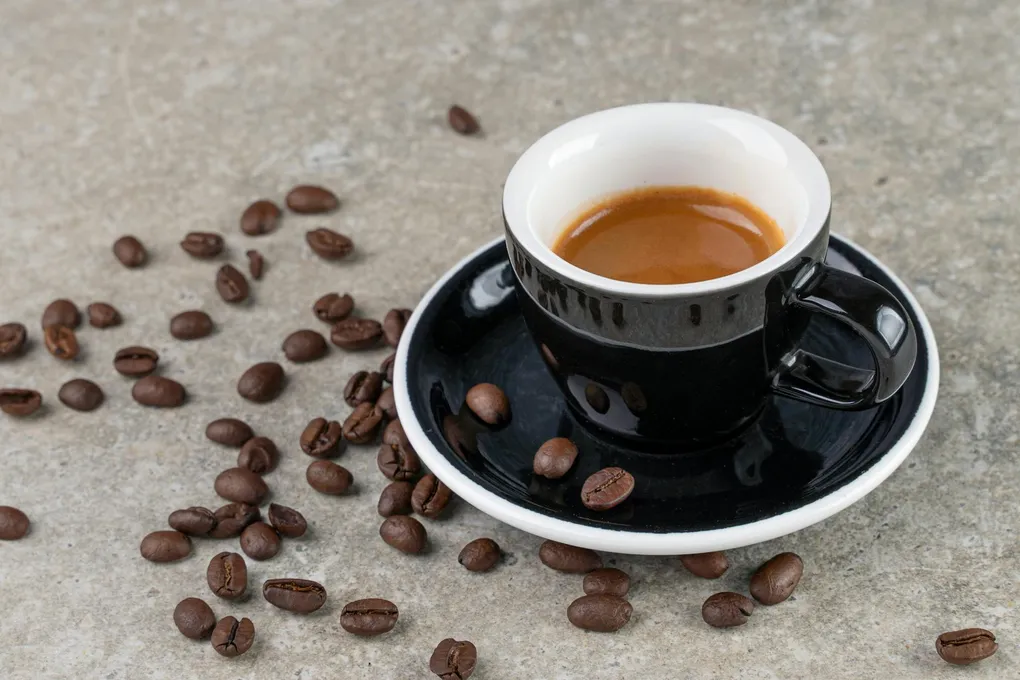
Ask someone which coffee has the most caffeine and they’ll almost always say espresso. It sounds right — espresso is intense, concentrated, and hits you like a wall. But it’s wrong. A single espresso shot contains about 63 mg of caffeine. A standard 8 oz cup of drip coffee contains 95–120 mg. Your morning pour over has roughly twice the caffeine of that shot of espresso you think is “stronger.”
This confusion exists because people conflate concentration with total dose. Espresso is the most concentrated coffee per milliliter — about 4,200 mg/L of caffeine. But you drink one ounce of it. Drip coffee is dilute by comparison — around 400–700 mg/L — but you drink eight ounces. Total caffeine delivered: drip wins by a wide margin.
This matters if you’re tracking intake, managing sleep, pregnant, or just curious about what you’re actually putting into your body. Here’s the real data.
Caffeine by Brew Method
The most reliable comparative data comes from a 2018 Newcastle University study that used HPLC analysis (high-performance liquid chromatography) on the same beans across multiple methods — controlling for the variable that makes most caffeine comparisons useless.
Per Serving (What You Actually Drink)
Per Milliliter (Concentration)
| Method | Caffeine Concentration (mg/L) |
|---|---|
| Espresso | ~4,200 |
| Moka pot | ~2,192 |
| Cold brew concentrate | ~2,240 |
| Turkish | ~1,000–1,250 |
| French press | ~742 |
| Pour over (V60) | ~692 |
| Cold brew (RTD) | ~560–700 |
| Drip/batch | ~400–700 |
| AeroPress | ~450–675 |
| Siphon | ~400–570 |
Look at those two tables together. Espresso is first in concentration and near-last in total per serving. Cold brew RTD is middling in concentration but first in total delivery. The method you choose matters — but mainly because it determines how much liquid you drink, not how “strong” the coffee is.
Myth #1: Espresso Has the Most Caffeine
It doesn’t — not per serving. A single espresso shot delivers roughly 63 mg. A standard drip coffee delivers 95–120 mg. If you order a double shot, you’re at about 126 mg — still in the range of a single 8 oz drip cup.
Where the myth comes from: espresso is the most concentrated caffeine delivery per ml. At 4,200 mg/L, it’s 6–10x more concentrated than drip. It tastes intense, it hits fast (smaller volume = faster absorption), and it’s served in tiny cups that look potent. But concentration and total dose are different things.
If you’re sensitive to caffeine and trying to reduce intake, switching from a 16 oz drip coffee to a single espresso actually cuts your caffeine in half. That’s counterintuitive, but the math is simple.
The exception: if you’re ordering a “large latte” at a coffee shop, you’re probably getting 2–3 shots (126–189 mg), which puts you right in drip territory. The milk and volume obscure the fact that you’re drinking multiple espressos.
Myth #2: Cold Brew Has Less Caffeine
This claim is serving-size dependent — and usually wrong as consumed.
Per milliliter, cold brew concentrate has less caffeine than espresso. True. But nobody drinks 1 oz of cold brew. A standard cold brew from a coffee shop is 16 oz, delivering 200–280 mg of caffeine — more than any other single serving on this list. The higher coffee-to-water ratio (1:5 to 1:8 vs drip’s 1:16) plus the large serving size makes cold brew the highest-caffeine drink most people consume.
If you make cold brew at home as a concentrate (1:7 ratio) and dilute 1:1, a 12 oz finished cup delivers roughly 100–140 mg — comparable to drip. It’s the undiluted or lightly diluted servings that push caffeine through the roof.
The “cold brew is smoother, so it must have less caffeine” logic doesn’t hold. Smoothness comes from lower titratable acidity and fewer volatile bitter compounds — it has nothing to do with caffeine content.
Myth #3: Dark Roast Has More (or Less) Caffeine
Neither. Roasting does not create or destroy caffeine. The molecule is remarkably heat-stable and survives the roasting process essentially intact.
The perceived difference is a measurement artifact:
By weight (grams): Dark roasted beans are lighter per bean — they’ve lost 16–18% of their mass to moisture and CO2 during roasting, and they’ve expanded in volume. So one gram of dark roast contains more beans than one gram of light roast. More beans = marginally more caffeine per gram.
By volume (scoops): Light roasted beans are smaller and denser. More beans fit in a scoop. More beans = marginally more caffeine per scoop.
The differences are tiny — a few percent at most. For practical purposes, a cup of light roast and a cup of dark roast brewed with the same weight of coffee contain the same amount of caffeine. If someone tells you “dark roast has more caffeine because it’s stronger,” they’re confusing flavor intensity with caffeine content.
How Your Body Processes Caffeine
Caffeine is a competitive antagonist of adenosine receptors (A1 and A2A). Adenosine is the molecule that makes you feel sleepy — it accumulates throughout the day and binds to receptors that slow neural activity. Caffeine fits into those same receptors without activating them, blocking adenosine from doing its job. The result: increased release of norepinephrine, dopamine, acetylcholine, serotonin, and glutamate. You feel alert, focused, and energized.
Effects begin within 15–60 minutes of ingestion and peak around 30–90 minutes.
Half-Life: Why the Same Cup Hits People Differently
Caffeine’s half-life — the time it takes your body to eliminate half of it — averages about 5 hours. But the range is enormous: 1.5 to 10 hours, depending on genetics, medications, and lifestyle.
The enzyme responsible for ~95% of caffeine metabolism is CYP1A2, encoded by a gene with a well-studied single nucleotide polymorphism. This divides people into two broad groups:
Fast metabolizers: Clear caffeine quickly. Can drink coffee at 4pm and sleep fine at 10pm. The half-life might be 2–3 hours.
Slow metabolizers: Clear caffeine slowly. A 2pm coffee disrupts sleep at midnight. The half-life might be 7–10 hours.
This isn’t about tolerance or willpower — it’s genetics. Caffeine clearance can vary up to 40-fold between individuals.
What Else Affects Clearance
| Factor | Effect on Caffeine Clearance |
|---|---|
| Smoking | Accelerates (induces CYP1A2) |
| Cruciferous vegetables (broccoli, cauliflower) | Accelerates (induces CYP1A2) |
| Oral contraceptives | Slows clearance |
| Pregnancy | Slows dramatically — half-life extends up to 3x, especially in the third trimester |
| Ciprofloxacin (antibiotic) | Inhibits CYP1A2 — can dramatically slow clearance |
| Grapefruit juice | May slow clearance |
| Alcohol | Mixed effects — acute consumption may slow it |
If coffee after 2pm keeps you awake, you’re likely a slow metabolizer. The practical solution is simple: set a personal caffeine cutoff time based on your own sleep patterns, not someone else’s. For slow metabolizers, that cutoff might need to be noon or earlier.
Safe Limits
General Population
The FDA considers up to 400 mg per day generally safe for healthy adults. That’s roughly:
- 4 cups of drip coffee (8 oz each)
- 6 shots of espresso
- 2 large cold brews (16 oz each)
Above 400 mg, some people experience anxiety, jitteriness, rapid heartbeat, or digestive discomfort. Others handle 600 mg without issue. The 400 mg guideline is a population-level recommendation, not an individual ceiling.
Pregnancy
ACOG (American College of Obstetricians and Gynecologists): No more than 200 mg/day — roughly 1.5–2 cups of drip coffee.
WHO: Less than 300 mg/day (more permissive than ACOG).
The pharmacology makes this limit important:
- Caffeine crosses the placenta freely — the fetus is exposed to the same blood concentration as the mother
- The fetus lacks the CYP1A2 enzyme and cannot metabolize caffeine
- The mother’s caffeine half-life extends up to 3x during pregnancy (especially in the third trimester), meaning caffeine accumulates faster than it clears
- Observational data associates excess intake with restricted fetal growth, low birth weight, and preterm birth
This is one of the rare areas where “moderation” has a specific, measurable number. Stick to it.
Children and Adolescents
No official FDA limit, but the American Academy of Pediatrics recommends against caffeine for children under 12 and suggests no more than 100 mg/day for adolescents (12–18). A single energy drink often exceeds this.
Caffeine and Time of Day: The Practical Math
Understanding half-life turns caffeine management from guesswork into arithmetic. If you drink a 16 oz cold brew (250 mg) at 8am and your half-life is 5 hours:
- 8:00 AM: 250 mg in your system
- 1:00 PM: 125 mg remaining
- 6:00 PM: 62 mg remaining
- 11:00 PM: 31 mg remaining
At 31 mg, most people can sleep. But if your half-life is 8 hours (slow metabolizer):
- 8:00 AM: 250 mg
- 4:00 PM: 125 mg
- 12:00 AM: 62 mg — still significant at midnight
Now add a second cup. A 2pm espresso (63 mg) on top of the morning’s remaining caffeine means you’re carrying 125 + 63 = 188 mg at 2pm. For the slow metabolizer, that’s still 94 mg at midnight.
This is why some people can drink coffee at dinner and sleep fine (fast metabolizer, 2-hour half-life: 63 mg at 7pm becomes 16 mg by 9pm), while others need to stop by noon. Neither person is right or wrong — they’re running different pharmacokinetics.
The practical takeaway: if you’re sleeping poorly, don’t reduce the strength of your coffee. Move the last cup earlier in the day. Caffeine timing matters more than caffeine amount for sleep.
The Health Snapshot
This isn’t a health article — our focus is caffeine content and metabolism. But the research landscape is worth a brief overview because it’s changed significantly in recent years.
The 2025 DECAF RCT (the first randomized controlled trial on coffee and atrial fibrillation) found that coffee drinkers were 39% less likely to have AFib recurrence than abstainers. This directly overturns the standard medical advice that heart patients should avoid coffee.
Neurological protection: Meta-analyses show roughly 30% lower Parkinson’s risk at 3 cups/day (especially in men) and 62–64% lower Alzheimer’s risk at 3–5 cups/day. The mechanism is both caffeine-dependent (adenosine blockade) and caffeine-independent (phenylindanes produced during roasting show neuroprotective properties in both caffeinated and decaf).
Type 2 diabetes: One of the most replicated findings in coffee epidemiology. 6% risk reduction per cup per day, reaching 33% at 6 cups. Remarkably, decaf works equally well — the non-caffeine compounds (chlorogenic acid, polyphenols) drive the benefit, not caffeine itself. Dark chocolate contains theobromine — a structurally related stimulant that’s gentler and longer-lasting than caffeine — and cacao percentage directly determines how much of it you’re getting.
Longevity: The largest meta-analysis (~3.8 million participants) found lowest all-cause mortality at 3.5 cups/day — a 15% risk reduction. A 2025 NHANES analysis found 1–2 cups/day associated with an average of 2 additional years of life expectancy.
These are observational findings, not prescriptions. Individual response varies, and “cups per day” in epidemiological studies rarely controls for brew method, serving size, or additions (sugar, cream). But the direction is consistent and robust across enormous sample sizes.
Decaf Isn’t Zero
Decaffeinated coffee still contains 3–6 mg of caffeine per 6 oz serving. The decaffeination process removes 94–97% of caffeine, not 100%. If you’re drinking 5 cups of decaf, you’re getting 15–30 mg — roughly half an espresso shot.
For most people, this is irrelevant. For people with extreme caffeine sensitivity or on medications that interact with caffeine (ciprofloxacin, fluvoxamine), it’s worth knowing.
Decaf also extracts differently: it has fewer available solubles (~19% EY vs. 20–21.5% for regular) and produces more fines when ground. Gagné recommends grinding decaf slightly coarser than you would the same bean caffeinated.
The Tool
Track your daily intake with our Caffeine Calculator — add each cup by method and see your running total against the 400 mg FDA guideline. It accounts for the per-serving differences across methods, so a single espresso and a 16 oz cold brew aren’t counted the same.
Sources & Further Reading
- Newcastle University (2018) — HPLC caffeine analysis across brew methods
- DECAF Trial (2025) — first RCT on coffee and atrial fibrillation
- Easto, J. & Willhoff, A. Craft Coffee: A Manual — roast level and caffeine
- Gagné, J. The Physics of Filter Coffee — decaf extraction differences
- Hoffmann, J. The World Atlas of Coffee — caffeine metabolism and history
- FDA, ACOG, WHO — safe caffeine limits
Frequently Asked Questions
- Does espresso have more caffeine than drip coffee?
- No — not per serving. A single espresso shot contains about 63 mg of caffeine. A standard 8 oz drip coffee contains 95–120 mg. Espresso is more concentrated per ml (about 4,200 mg/L vs. 400–700 mg/L for drip), which is why it tastes more intense. But total caffeine delivered depends on serving size, and drip's larger volume wins.
- How much caffeine is in cold brew?
- It depends entirely on serving size and dilution. A 16 oz ready-to-drink cold brew can contain 200–280 mg — more than any other single serving. But a 2 oz shot of cold brew concentrate has only 70–120 mg. The 'cold brew has less caffeine' claim is true per ml compared to espresso, but false as typically consumed in large servings.
- Does dark roast have more caffeine than light roast?
- No. Roasting doesn't create or destroy caffeine — the molecule survives roasting intact. The tiny differences people measure come from how you dose: by weight, dark roast has slightly more caffeine (lighter beans = more beans per gram); by scoop, light roast has slightly more (denser beans = more beans per scoop). Brewed with the same weight of coffee, the caffeine is essentially identical.
- Why does coffee affect me more than my friends?
- Genetics. The CYP1A2 enzyme handles ~95% of caffeine metabolism, and a common gene variant divides people into fast and slow metabolizers. Clearance can vary up to 40-fold between individuals. If coffee after 2pm keeps you awake, you're likely a slow metabolizer. This isn't tolerance — it's your DNA. Set your caffeine cutoff based on your own sleep patterns.
- How much caffeine is safe during pregnancy?
- ACOG recommends no more than 200 mg/day (about 1.5–2 cups of drip coffee). WHO allows up to 300 mg. The concern is real: caffeine crosses the placenta freely, the fetus can't metabolize it (lacks the CYP1A2 enzyme), and the mother's half-life extends up to 3x during pregnancy. Excess intake is associated with restricted fetal growth and low birth weight.
- Is decaf really caffeine-free?
- No. Decaffeination removes 94–97% of caffeine, leaving 3–6 mg per 6 oz serving. Five cups of decaf delivers roughly 15–30 mg — about half an espresso shot. Negligible for most people, but worth knowing if you have extreme sensitivity or take medications that interact with caffeine.